







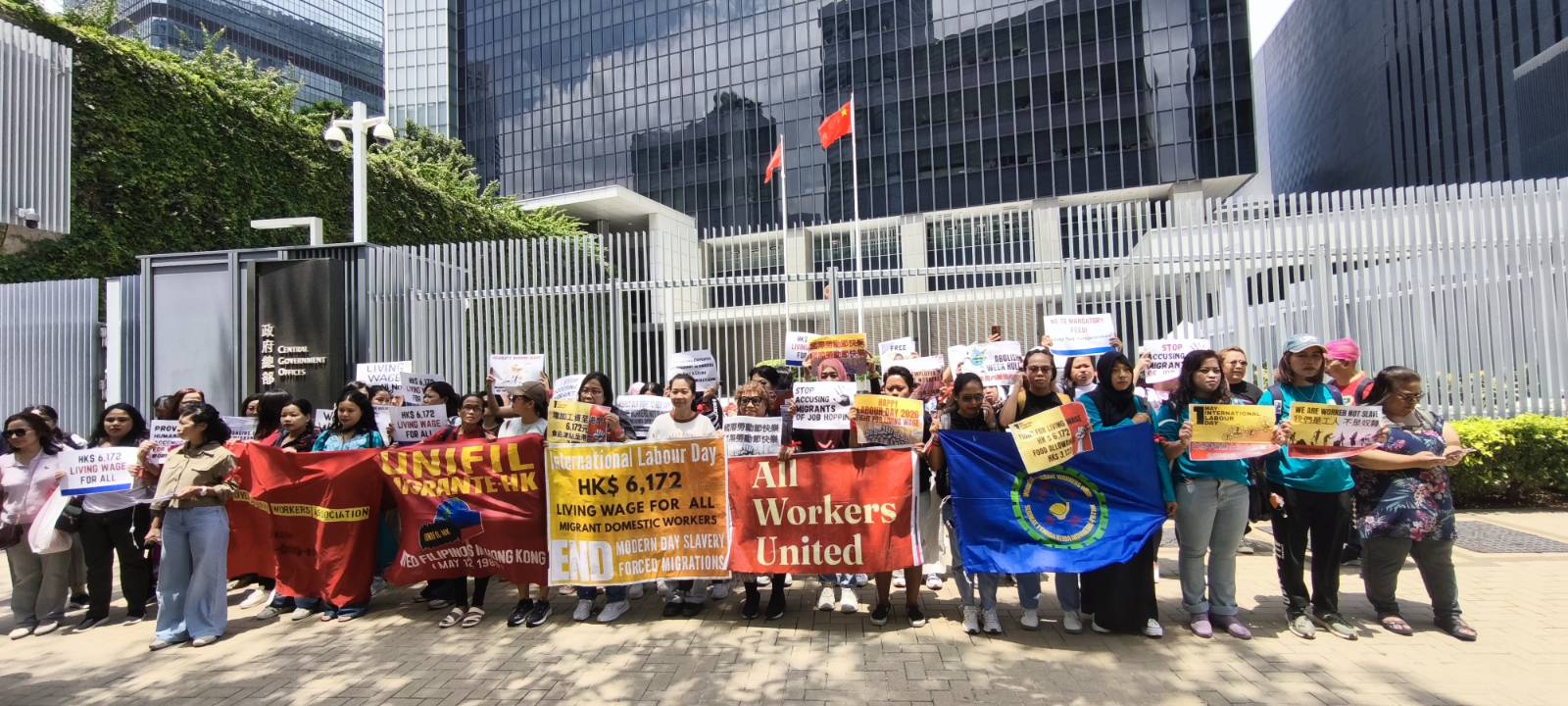
HONG KONG — A coalition representing migrant domestic workers in Hong Kong and Macau returned to the streets on International Labour Day Thursday for the first time in six years, staging a protest outside the Central Government Office to demand better wages, regulated working hours, and improved living conditions.
The Asian Migrants Coordinating Body (AMCB-IMA HK and Macau) marked May 1st with renewed urgency, citing findings from a study session held last week that painted a stark picture of deteriorating conditions for the city’s migrant domestic worker (MDW) population.
Longer Hours, Lower Pay
The April 26 study session, which lasted three hours and drew 50 participants — 20 of them representing migrant organizations — found that working hours have worsened significantly. Where previous reports documented workdays of up to 16 hours, the new findings show that approximately 64% of respondents, or 32 out of 50, now work between 18 and 20 hours daily. Some workers reported beginning their duties as early as 5:45 a.m. and finishing past 1:00 a.m.
“In almost three decades of struggle by migrant domestic workers in Hong Kong, working conditions have not improved,” the group said in a statement. “In fact, they have gotten worse.”
On rest days, 80% of respondents said they were required to work before and after their scheduled day off, with some only permitted to leave their employer’s home around 10:00 a.m. and subject to a 7:00 p.m. curfew.
Wages and Debt
The wage situation remains dire, according to the group. Six percent of respondents reported being paid below the legally mandated minimum wage, with many too fearful of job loss to file complaints. Workers who had been employed by the same household for a decade reported average wages of only HK$5,000 to HK$5,500 per month.
“Migrant domestic workers are drowning in debt because they are victims of low wages, high inflation, and a rising cost of living,” the AMCB said, adding that neither sending nor host countries have established a livable wage for MDWs, which the group says is fueling forced migration.
Recruitment agency fees in sending countries continue to compound the financial burden, averaging between HK$13,000 and HK$30,000. The group also documented increasing complaints about substandard agency-provided accommodation, with some workers charged HK$50 to HK$100 per day for facilities described as unsafe and poorly maintained — with some workers sleeping on the floor.
Living Conditions and Terminations
Seventy percent of respondents reported sharing sleeping quarters with children or elderly members of the household, leaving little room for adequate rest. The AMCB warned that the lack of proper rest is taking a severe physical, emotional, and mental toll on workers.
The group also flagged a rise in premature contract terminations. Nearly 16% of respondents said they had been dismissed within nine days to four months of beginning employment, while 6% were terminated between seven months and one year into service — often without clear or valid reason.
Despite a 2017 policy banning employers from requiring domestic workers to clean exterior windows — a measure won following a series of fatal falls — three out of 50 respondents said they were still being asked to perform the task.
Seven-Point Demand
Under the banner of the All Workers United Hong Kong network, the AMCB issued a seven-point list of demands to the Hong Kong government, including:
- Ratification of ILO Convention 189, which recognizes domestic workers as workers, and the inclusion of MDWs under the statutory minimum wage, with enforcement of a HK$6,172 living wage and HK$3,123 food allowance.
- Approval of a HK$62.8 living wage for local workers.
- Legislation regulating working hours for all workers, including a mandatory 11-hour continuous rest period between consecutive workdays for live-in domestic workers.
- Clearer standard employment contracts specifying working hours, rest periods, accommodation standards, and food provisions.
- Strict enforcement and penalties for violations of the window-cleaning ban.
- Review of discriminatory policies, including the live-in requirement and the two-week rule, which the group argues trap abused workers and force heavily indebted employees to endure mistreatment.
- Thorough investigations into unscrupulous recruitment agencies.
“Modern-Day Slavery”
The AMCB, which re-launched its “3W Campaign” — advocating for a living wage, an end to excessive working hours, and better working conditions — last year, said Thursday’s protest marked a significant moment after six consecutive years in which May Day actions were not held.
“Neoliberal and anti-migrant policies are what lead to discrimination and inhumane treatment of migrant domestic workers,” the group said. “It is clear that modern-day slavery continues in a modern city such as Hong Kong.”
The group vowed to continue its advocacy beyond May 1st. “Until the Hong Kong government finally hears and resolves the issues that make workers suffer, we will continue the fight for a society that treats workers as inherently human,” it said.
Hong Kong is home to approximately 340,000 migrant domestic workers, the majority from the Philippines and Indonesia.