








Cinderella didn’t plan on eating just one meal a day. But that’s where she found herself — counting dirhams in her Dubai apartment, calculating whether she could afford both food and rent, knowing the answer was rarely yes.
For nearly three years, she had worked as a household helper for a Syrian family in Dubai. Then the US-Iran conflict erupted, and they were gone — leaving the UAE out of fear, like so many others. Cinderella scrambled to fill the gap with part-time cleaning jobs and holistic massage sessions, but the work was sporadic and meager. Her monthly rent of $163 barely stayed covered. Sending money back to her mother in the Philippines — the very reason she had come to the Gulf in the first place — had become a luxury she could seldom afford.
“It felt like a disaster,” she said quietly.
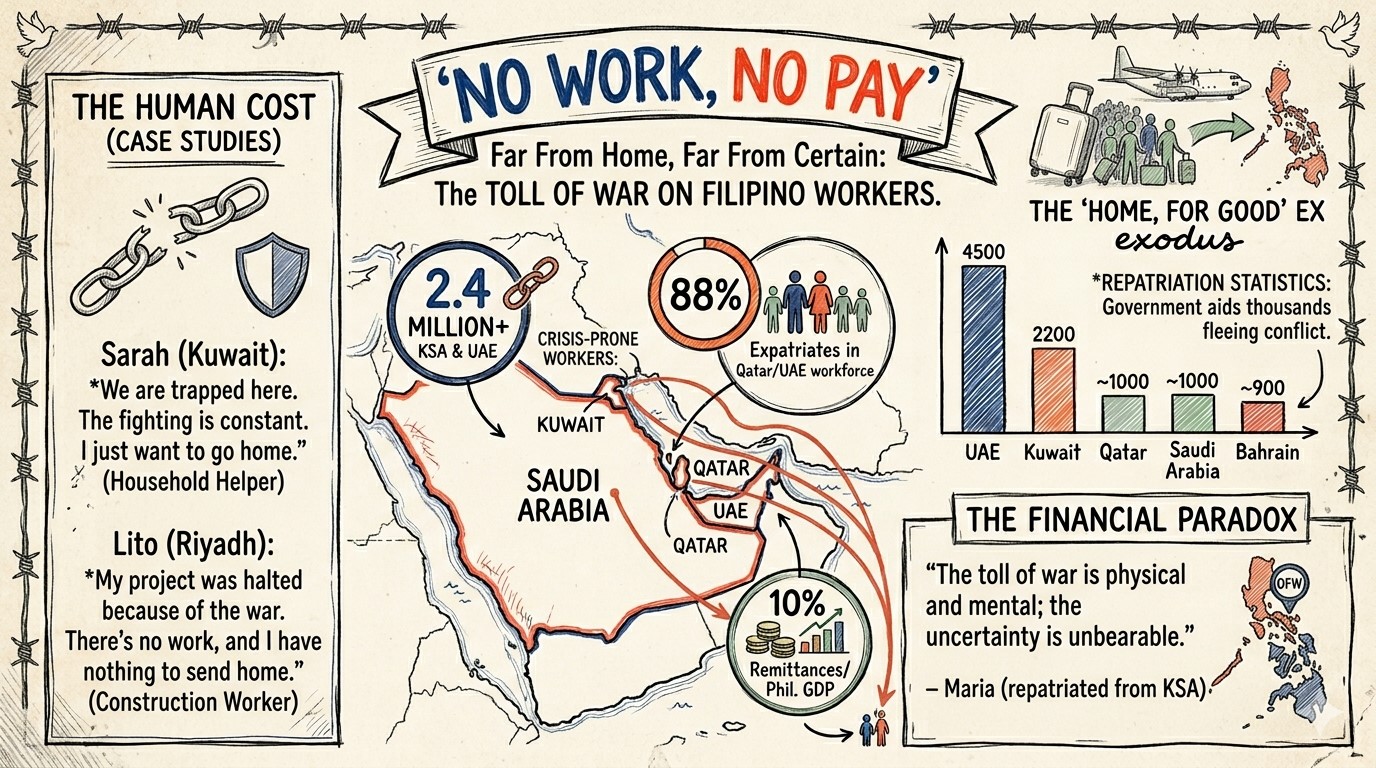
She is not alone. Across the Gulf, more than 2.4 million Overseas Filipino Workers (OFWs) — nurses, hotel staff, domestic helpers, retail workers — found their lives upended when the conflict entered its third month. The war, still simmering, didn’t just rattle governments and markets. It quietly shattered the carefully balanced financial lives of millions of migrant workers who had built their families’ futures on wages four to five times higher than what they could earn back home.
A Pink Slip in Doha
For Kim, the blow came through a termination paper handed to her at the luxury hotel in Doha where she had worked for three years. The hotel, bracing for a downturn it could already see coming, began cutting staff — particularly those in senior positions. About 200 employees from France, India, Nepal, Bangladesh and several Arab countries received the same news. Kim was among them.
“There was really no money coming in,” she said.
She was offered a chance to retract her termination, but declined. After nearly eleven years in the UAE and three in Qatar — almost a third of her life spent in the Middle East — she decided it was time to go home.
“I just want to find time to relax, clear up the sad memory of losing my work amid explosions,” she said. “It was scary. But I’m thankful the government didn’t abandon us. I felt safe.”
The Decision to Leave — For Good
For Tere and her husband, the war didn’t create the plan to go home — it simply accelerated it. The couple had already been thinking about leaving Bahrain and returning permanently to the Philippines. When the conflict froze ongoing projects and tightened business conditions, they stopped hesitating.
“The move back to Manila is permanent,” Tere said plainly.
Some of her friends chose to stay, especially after realizing that the drones and missiles lighting up the sky weren’t aimed at them. But Tere’s mind was made up. “I hope this conflict gets resolved soon,” she said. “It’s negatively affecting people all over the world — even back home.”
A Nation’s Lifeline, Under Pressure
The stakes extend far beyond individual paychecks. OFW remittances account for roughly 10 percent of the Philippine economy. When those transfers slow — or stop — it doesn’t just hurt families. It ripples through an entire nation.
Cindy, who had lived and worked in the UAE for nearly two decades, felt the weight of that reality crash down on her all at once.
“The recent conflict affected me financially and mentally,” she said. “It was fear and uncertainty.”
She packed her bags and flew home. She is now among more than 11,000 Filipinos who have sought government repatriation assistance through chartered and commercial flights — the largest numbers coming from the UAE, Kuwait, Saudi Arabia, Qatar, and Bahrain, with many bringing along spouses, children, and extended family members.
Back home, she is still searching for stable income, exploring small business ideas, and adjusting to life in a country she left behind so many years ago.
“Safety and security will always be my main priority,” she said. But she left the door open: “I may still consider returning to the UAE once the situation becomes stable.”
A Government Scrambling to Catch Up
The Philippine government has not been idle. Migrant Workers Secretary Hans Leo Cacdac revealed that as many as 70 percent of repatriated OFWs expressed a desire to return to the Gulf once the war ended — many of them still holding valid work visas.
To help them bridge the gap, the government launched a crisis response package covering ten countries across the Middle East, offering a one-time $200 financial assistance to those who lost work or income. More than 4,500 Filipinos had already received it, with more expected as the program expanded. The package also included psychosocial support, livelihood training, entrepreneurship programs, and healthcare guidance.
“The repatriation efforts and provision of necessary support to ensure the safe and orderly return of affected OFWs will continue,” Cacdac said.
Not Going Back — At Least, Not to the Philippines
As for Cinderella, she recently landed a steady job with a cleaning crew — a small but meaningful turn of fortune. Repatriation, for her, is off the table. But so is staying in Dubai forever.
“When things get better here, I am planning to leave,” she said. “But not for the Philippines — for Cairo, where I previously worked for ten years and my employment situation was better.”
It’s a quietly remarkable statement — a woman who has remade herself across three countries, navigating wars and lost wages and solitary meals, still plotting her next move with calm, stubborn resilience.
For millions like her, home is not a place. It’s wherever the next paycheck can be found.
Adapted from original source: Arab News – “No work, no pay: War hits hard OFWs in the Middle East”
Infographic: HKPinoyTV