





On the morning of April 28, 2026, a quiet announcement from Abu Dhabi’s state news agency sent shockwaves through energy ministries, trading floors, and foreign policy circles from Washington to Riyadh. The United Arab Emirates — a founding pillar of the OPEC oil cartel for nearly six decades — was walking out the door. Effective May 1. No long goodbye. No negotiated transition. Just a clean, decisive break that nobody saw coming — and that everyone will be talking about for decades.
More Than Just Oil: A Nation Choosing Its Side
Let’s be honest — this was never purely about barrels per day. Yes, the UAE has long been frustrated with OPEC’s production quotas. Yes, Abu Dhabi has chafed for years under Saudi Arabia’s iron grip on the cartel’s output decisions. But the timing, the tone, and the geopolitical context of this exit tell a far bigger story.
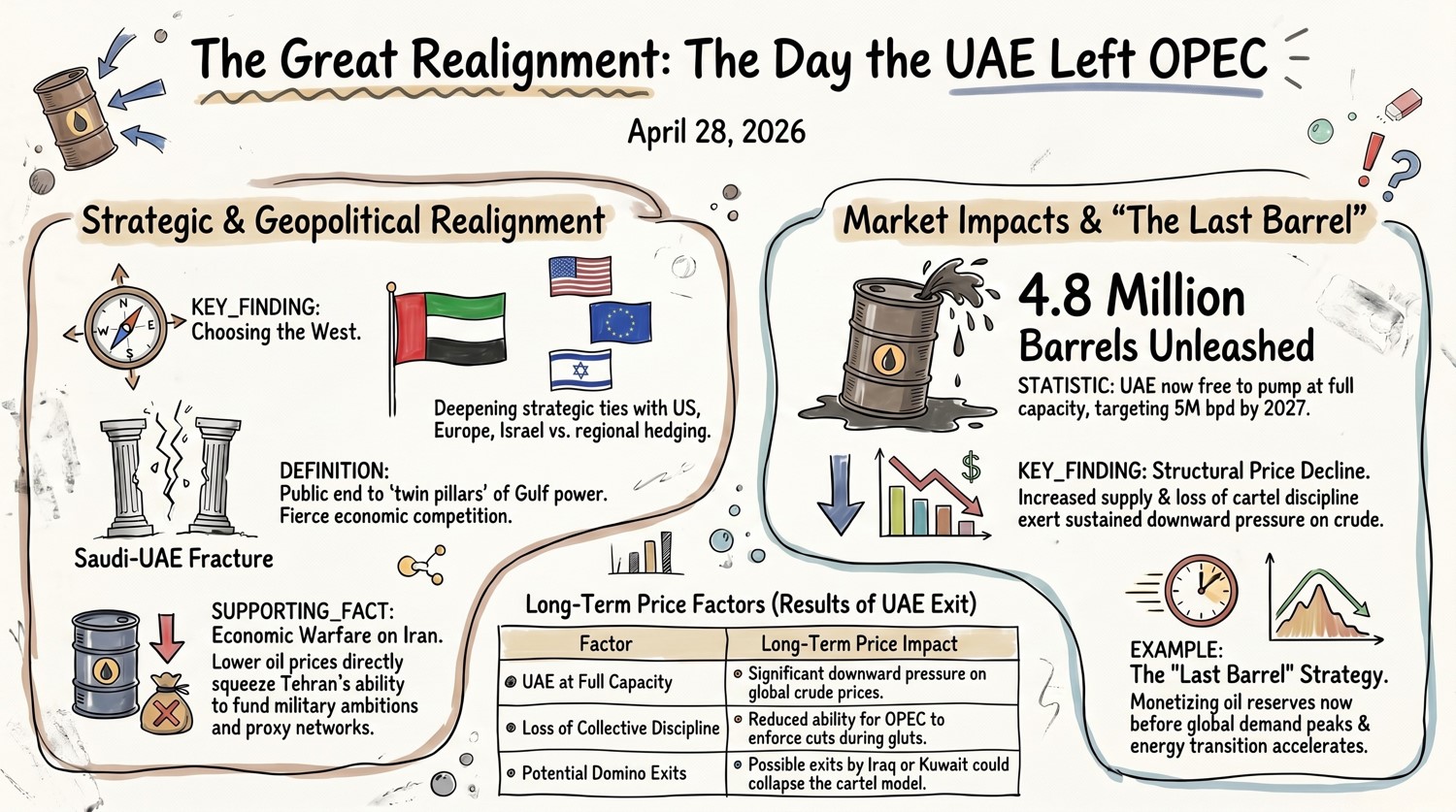
The UAE is choosing its allies. And it is choosing the West.
Think about what has happened in the months leading up to this moment. Iran — just across the narrow Strait of Hormuz — has been raining missiles and drones on UAE shipping and infrastructure as part of the broader US-Israeli war with Tehran. The UAE has been on the front lines, literally. And when it looked around at its Arab neighbours and fellow OPEC members for solidarity, what did it find? Hedging. Equivocation. Silence.
Anwar Gargas, the diplomatic adviser to the UAE president, said it plainly at the Gulf influencers’ forum just days before the OPEC exit: Arab and Gulf states had “hedged, equivocated and, in some cases, pressed for their own agendas even as states were under attack.” That is the language of a nation that has made up its mind. The OPEC exit was the punctuation mark at the end of a sentence that had been building for years.
“During our time in the organization, we made significant contributions and even greater sacrifices for the benefit of all. However, the time has come to focus our efforts on what our national interest dictates.” — UAE Ministry of Energy Statement, April 28, 2026
In its place, the UAE is deepening ties with the United States, Europe, and Israel — a realignment that would have been almost unthinkable a decade ago. The US Federal Reserve and the UAE Central Bank have even discussed a currency swap agreement, a financial lifeline that signals just how close the two nations have grown. This is not a transactional relationship. This is a strategic partnership being cemented in real time, under fire, with the Strait of Hormuz as the backdrop.
Trump’s Quiet Triumph: The Cartel Cracks
If there is one world leader who woke up on April 28 with a satisfied smile, it was Donald Trump. For years — across both of his presidencies — Trump has railed against OPEC with a fury that was equal parts economic grievance and political theatre. He called the cartel out for “ripping off the rest of the world” by artificially inflating oil prices. He pressured Saudi Arabia. He celebrated every dip in crude prices as a personal victory. And now, without firing a single shot at OPEC directly, he has watched one of its most powerful members walk away.
This is a geopolitical win of the first order for Washington — and for the broader US-Israel alliance that has been prosecuting the war against Iran. Here is why it matters so profoundly:
OPEC’s power has always rested on collective discipline. When members agree to hold back production, prices stay elevated. Those elevated prices fund the petrostate economies of the Gulf — including, critically, Iran’s ability to finance its military ambitions and proxy networks across the Middle East. A weaker OPEC, producing more oil at lower prices, is a direct squeeze on Tehran’s revenues. It is economic warfare by another name, and it suits Washington perfectly.
Beyond Iran, cheaper oil serves Trump’s domestic agenda. Lower energy prices ease inflation, boost consumer spending, and give the US economy room to breathe. Trump has always understood that cheap oil is a political gift, and the UAE’s exit from OPEC moves the world meaningfully closer to that reality.
For Israel, the strategic calculus is equally compelling. A UAE that is openly aligned with the US-Israel axis, that has broken with the Saudi-led Arab bloc, and that is pumping oil freely into global markets — weakening Iran’s financial base — is an invaluable partner. The Abraham Accords of 2020 were the diplomatic foundation. The OPEC exit of 2026 may prove to be the economic superstructure built upon it.
The Saudi Sting: A Rivalry Goes Public
For Saudi Arabia, this is a wound that goes deeper than oil policy. The UAE and Saudi Arabia were once the twin pillars of Gulf Arab power — brothers in arms, partners in prosperity, united by religion, culture, and shared strategic interests. That relationship has been quietly fraying for years, and the OPEC exit has now made the fracture visible to the entire world.
The two nations have backed opposing sides in Yemen. They have competed fiercely for foreign investment, tourism, and the title of the Gulf’s premier business hub. Saudi Vision 2030 and the UAE’s own economic transformation agenda have put them in direct competition for the same pools of global capital and talent. And now, on the most fundamental question of oil policy, they have publicly parted ways.
Saudi Arabia still controls enormous spare capacity and retains significant market influence. But managing OPEC without the UAE — without its spare capacity buffer, without its compliance, without its credibility — is a fundamentally harder task. Riyadh now leads a cartel that is visibly diminished, and every other member will be watching to see whether the Saudi-led model still commands respect.
“It is a blow to the Saudis because it undermines their ability to manage OPEC as an organization.” — David Goldwyn, Former US State Department Special Envoy for International Energy Affairs
The Big Prize: Could Oil Prices Fall — and Stay Low?
Here is where things get genuinely exciting for the average person on the street — the driver filling up at the pump, the airline booking fuel for its fleet, the manufacturer calculating energy costs. Because the long-term trajectory of global oil prices, post-UAE exit, points in one direction: down.
The mechanism is straightforward. The UAE has a production capacity of approximately 4.8 million barrels per day and has set a target of 5 million bpd by 2027. Under OPEC, it was producing significantly less than that — holding back oil in service of the cartel’s collective price management strategy. Now, those constraints are gone. Once the Strait of Hormuz reopens — and it will — the UAE will pump at maximum capacity, acting as a “normal non-OPEC producer” that simply produces as much as it can.
That additional supply — potentially hundreds of thousands of extra barrels flooding into global markets every single day — will exert sustained downward pressure on crude prices. And the UAE will not be alone. If its exit emboldens other OPEC members to reassess their own membership — Iraq, Kuwait, and others have their own quota grievances — the collective restraint that has kept oil prices elevated for decades could unravel with remarkable speed.
The UAE’s strategy is also shaped by a clear-eyed reading of the energy transition. Abu Dhabi knows that global demand for oil will eventually peak and decline as electric vehicles, renewables, and efficiency improvements reshape the energy landscape. The smart play — and the UAE is nothing if not strategically smart — is to monetise your reserves now, while the world still needs them, rather than sit on them under OPEC quotas and watch their value erode.
This “last barrel” logic, if adopted by other major producers, could trigger a race to produce that sends oil prices into a prolonged structural decline. Think of it as the oil market equivalent of a bank run — once enough producers decide to get their money out before the window closes, the rush becomes self-reinforcing.
“Probably lower oil prices, but also more volatile oil prices.” — Jorge León, Head of Geopolitical Analysis, Rystad Energy
The volatility caveat is important. The loss of the UAE’s spare capacity from OPEC’s toolkit means the world has less of a shock absorber when crises hit. So while the average price of oil may trend lower over the coming decade, the spikes — when they come — could be sharper and more painful than anything we have seen before. For consumers, that means cheaper petrol most of the time, punctuated by occasional price shocks that feel like whiplash.
The Bigger Picture: A New Energy World Order
Step back from the daily headlines and the barrel counts, and what you see is a world in the middle of a profound energy transition — not just from fossil fuels to renewables, but from the old geopolitical order of oil cartels and petrodollar diplomacy to something new and not yet fully defined.
The UAE’s exit from OPEC is a milestone in that transition. It signals that even the most committed oil producers are beginning to act on the understanding that the age of collective oil market management is ending. The future belongs to producers who are lean, low-cost, and strategically aligned with the consuming nations of the West — not to cartels that try to hold back the tide of supply to prop up prices.
For the United States and its allies, this is a moment of genuine strategic opportunity. A world with lower, more competitive oil prices is a world where petrostates have less money to fund destabilising activities, where consumers have more spending power, and where the economic case for the energy transition becomes even more complex and interesting.
For OPEC, the question is existential. Can an organisation that has lost its third-largest producer — and one of its only two members with meaningful spare capacity — remain relevant? History suggests that cartels, once they begin to crack, rarely recover their former cohesion. The cracks in OPEC are now visible to everyone.
The Bottom Line
The UAE’s exit from OPEC is one of those rare moments when a single decision reshapes the landscape of global power, economics, and geopolitics all at once. It is a story about a small but extraordinarily ambitious nation choosing its future — and choosing the West. It is a story about Donald Trump’s long campaign against OPEC finally bearing fruit in the most dramatic way imaginable. It is a story about Saudi Arabia’s regional dominance being openly challenged by its closest former ally.
And above all, it is a story about oil — the commodity that has shaped the modern world — becoming cheaper, more abundant, and less controllable by the handful of nations that once held the global economy hostage to their production decisions.
The age of OPEC omnipotence may not be over yet. But on April 28, 2026, it took a blow from which it may never fully recover. And for the billions of people around the world who pay for energy every single day, that might just turn out to be very good news indeed.
Sources: NPR, The Guardian, CNBC, Bloomberg, Gulf News, New York Times | Analysis based on reporting from April 28, 2026 | All figures and quotes sourced from named analysts and official statements.
WordPress tips: Use the bold text as headings (H2 or H3 in the block editor), the > quoted lines as WordPress Quote blocks, and the — dividers as Separator blocks for a clean, readable layout.