







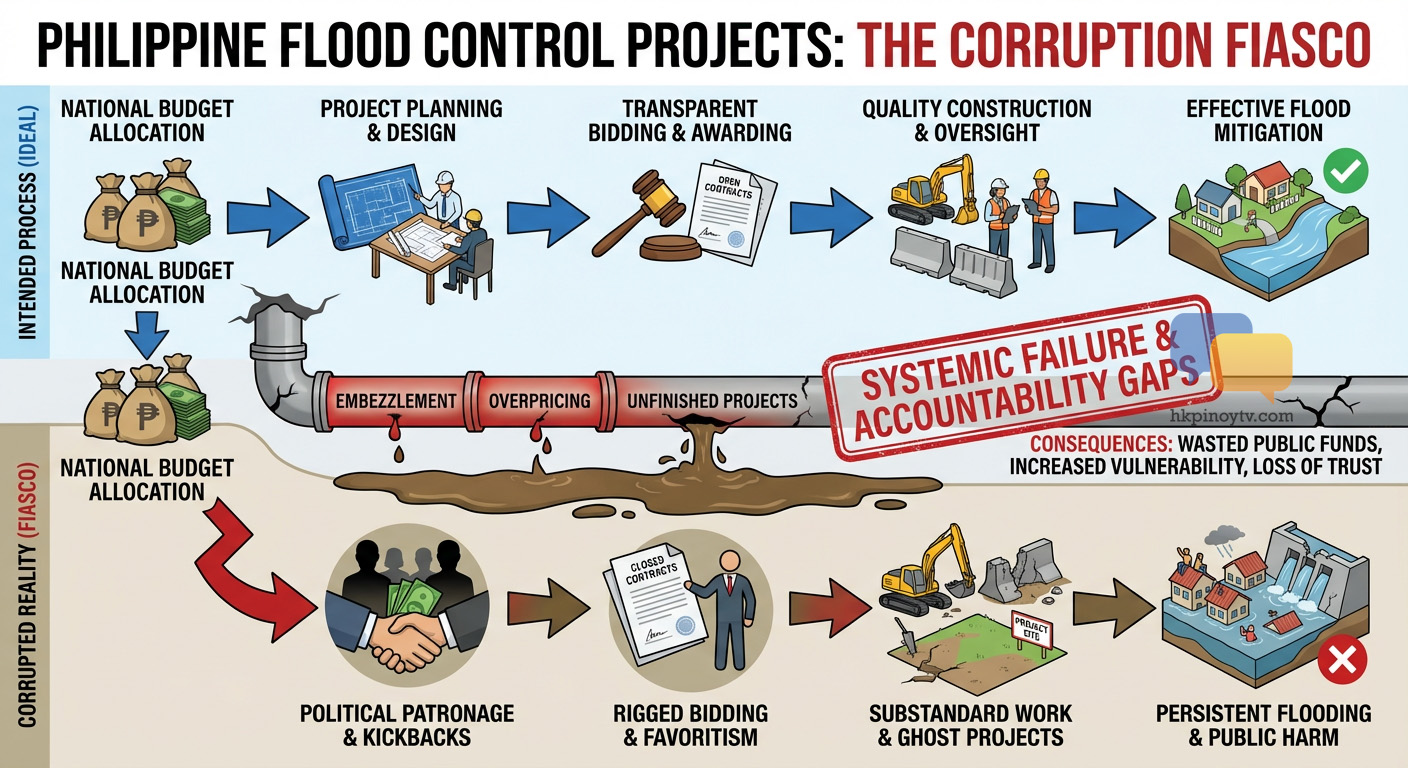
Imagine billions allocated to protect your home from floods, only for the waters to rise higher than ever. That’s the tragic, infuriating reality unfolding in the Philippines. Monsoons become harbingers of dread, not just due to the elements, but because of the knowledge that supposedly protective infrastructure is either non-existent or structurally unsound.
The Philippine government is grappling with a massive corruption scandal in its flood control projects – a saga of “ghost” infrastructure, shoddy work, and eye-watering sums vanishing into thin air. It’s a cruel paradox: funds meant to mitigate disaster instead fueling it, washing away not just homes but also trust in the very institutions designed to serve.
As of late 2025, arrest warrants are flying, big names are implicated, and President Marcos Jr. is on a warpath. This isn’t just about money; it’s about lives lost, livelihoods destroyed, and a nation’s trust eroded – a trust that, frankly, has been strained for far too long.
A Very Muddy History: Corruption’s Deep Roots
Sadly, this isn’t the first time corruption has plagued public works in the Philippines. We’re talking generations of graft, a pervasive culture that has, unfairly, earned the country a reputation for “a thousand years of corruption.” It’s a heavy burden, this historical baggage, but one that must be acknowledged if any progress is to be made.
Consider the echoes of the past:
- Early 2000s: We shudder to recall “tong-pats” – those notorious kickbacks adding a neat 12% to project costs under the Arroyo administration. Twelve percent! A seemingly arbitrary number that nonetheless represents a concrete betrayal of public trust.
- Aquino III Era: Efforts were made, reforms were attempted, yet the siren song of easy money proved too tempting. “Pork barrel” funds and local deals still saw billions siphoned off, leading to the infamous 2013 PDAF scam with its brazen “ghost” NGOs.
- Duterte Years: Budgets for flood control exploded, creating a feeding frenzy, a veritable gold rush for the unscrupulous. Even blacklisted contractors – individuals and firms already known for their dubious practices – were still winning lucrative bids, a testament to the depth of the rot.
The blueprint of betrayal is chillingly consistent. “Ghost” projects that only exist on paper, a cartographer’s fantasy rather than a concrete reality. Cheap materials passed off as quality, a calculated risk taken with the lives and security of ordinary citizens. Rigged bids favoring buddies, a blatant disregard for fair competition and the public good. And, of course, kickbacks – often 20% or more! – for everyone from local engineers to high-ranking officials. It’s almost institutionalized, a deeply ingrained system of patronage and plunder.
The Current Cascade: Marcos Jr.’s Crackdown
President Marcos Jr. isn’t holding back, calling the situation “horrible” and launching a sweeping investigation in July 2025. His promise? “No special treatment, and nobody spared.” Strong words, but will they translate into meaningful action?
The investigation has already yielded some tangible results:
- The “Dirty Dozen” (and then some!): 18 individuals, including former lawmaker Zaldy Co (who apparently packed his bags and fled!), DPWH engineers, and construction firm bigwigs, are facing the music for a P289M river dike project in Oriental Mindoro.
- In Custody: At least eight are already behind bars, with prosecutors recommending no bail – a sign of the gravity of the alleged offenses.
But this is just the tip of the iceberg. Investigations are scrutinizing 9,855 projects worth over P545 BILLION since mid-2022, with a staggering P118.5 BILLION estimated lost to corruption since 2023 alone. “Ghost” projects in Bulacan? They’re definitely on the list, a haunting reminder of the money that vanished without a trace, leaving communities vulnerable and exposed.
Public Outcry & Political Quakes: Who’s Saying What?
Unsurprisingly, the public is furious. From Manila rallies to online outrage, the collective anger is palpable. People are demanding accountability for projects that failed them when typhoons struck, branding offenders as “climate criminals” for plundering climate adaptation funds.
The scandal has already claimed some high-profile casualties: two cabinet members out, and even the President’s cousin, former House Speaker Martin Romualdez, stepping down after being implicated (he denies it, naturally). These resignations, whether prompted by genuine guilt or political expediency, are a clear indication of the pressure the administration is under.
The Office of the Ombudsman is on the case, working with the special anti-corruption court, Sandiganbayan. While “plunder” charges can be tough to prove, malversation, bribery, and falsification are expected to stick.
What’s Next? Diking Off Corruption (Hopefully!)
The fight is far from over. Philippine authorities aren’t done yet, with an ongoing search for remaining suspects and Interpol potentially involved. The Independent Commission for Infrastructure (ICI) expects to implicate as many as 1,200 individuals!
The Anti-Money Laundering Council is moving to freeze ill-gotten gains, attempting to claw back some of the stolen wealth.
Perhaps most significantly, P225 BILLION originally allocated for flood control in the 2026 budget is being re-routed to education, health, and other crucial services. This represents a massive pivot, a tacit admission that the current system is broken.
There’s a glimmer of hope for systemic reform: stricter project approval processes, more rigorous performance audits, and a crackdown on bid-rigging. Civil society is pushing for genuine Freedom of Information and Beneficial Ownership Transparency laws to prevent future abuses.
But let’s not be naive. This is just the beginning of a prolonged, arduous battle against deeply entrenched corruption. Can the Philippines finally clean up its act and build infrastructure that truly protects its people? Only time will tell. The waters may recede, but the stain of corruption lingers, a constant reminder of the challenges that lie ahead.