








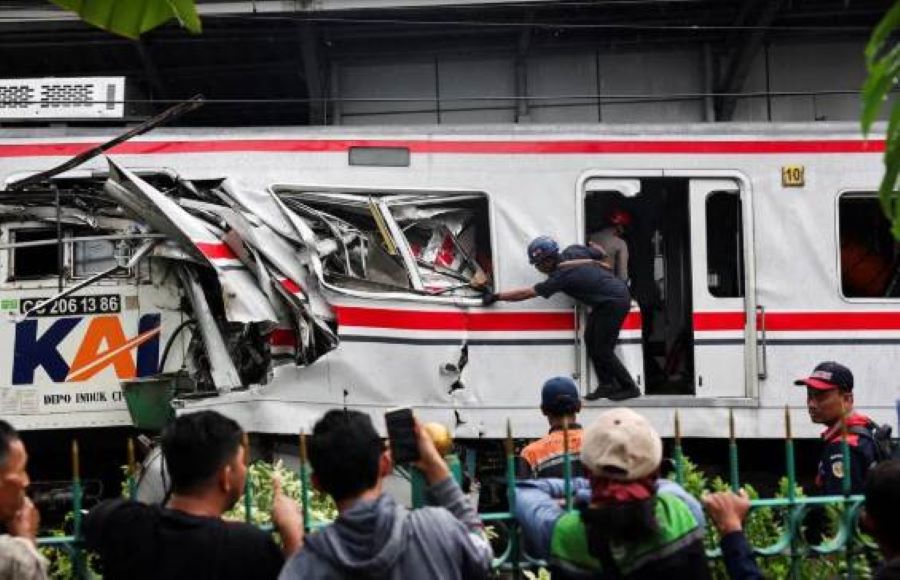
Indonesia’s president ordered an immediate investigation Tuesday after a long-distance train collided with a stationary commuter train near the capital Jakarta overnight, killing at least 14 people and injuring dozens more in one of the country’s deadliest rail disasters in years.
Rescue workers spent nearly 12 hours prying open mangled carriages at Bekasi Timur Station, about 25 kilometers east of Jakarta, before officials declared the operation complete Tuesday morning.
“I am certain there are no more victims to be found,” Mohammad Syafii, head of the National Search and Rescue Agency, told reporters.
State-owned rail operator KAI confirmed the death toll had risen to 14, with another 84 people requiring medical treatment. All victims were aboard the commuter train. The roughly 240 passengers on the long-distance train were evacuated safely, according to KAI spokeswoman Anne Purba.
‘I Thought I Was Going to Die’
Among the survivors was Sausan Sarifah, 29, who was heading home from work Monday night when her commuter train stopped at Bekasi Timur Station.
“It all happened so fast, in a split second,” she said from her hospital bed at RSUD Bekasi, where she was being treated for a broken arm and a deep gash to her thigh. “There were two announcements from the commuter train. Everyone was ready to get off, and then suddenly there was the sound of the locomotive, really loud.”
Sausan said passengers had no time to escape before the impact sent them tumbling into one another inside the crushed carriage.
“There was no time to get out, and everyone ended up piled up inside the train, crushed on top of one another,” she said. “I don’t know how the person underneath me is doing.”
She said she feared suffocating beneath the crush of bodies. “Thank God I was on top, so I could be evacuated quickly,” she added.
A Taxi May Have Triggered the Disaster
KAI spokesman Franoto Wibowo said investigators believe a taxi clipped the commuter train at a level crossing, causing it to stall on the tracks — where it was then struck by the oncoming long-distance train. Jakarta police chief Asep Edi Suheri confirmed the collision struck the last carriage of the commuter train, a women-only car.
Chaotic scenes unfolded in the immediate aftermath. An AFP reporter at the scene witnessed rescue workers shouting for oxygen tanks as a snaking queue of ambulances waited nearby, lights flashing. Hundreds of bystanders looked on as the injured were carried out on gurneys. The military, fire brigade, national search and rescue agency, and the Red Cross all participated in the evacuation effort.
President Visits Victims, Vows Action
President Prabowo Subianto visited injured passengers at the Bekasi hospital Tuesday, offering condolences to the families of the deceased and pledging swift action.
“In general, we do see that many railway crossings are not guarded,” Prabowo said. “I have ordered that we immediately repair all these crossings, either by guard posts or by flyovers.”
He also announced the construction of an overpass in Bekasi and said he had directed authorities to launch an immediate investigation into the crash.
KAI said it would cover all medical expenses for the injured and funeral costs for those killed.
A Nation With a Troubled Transport Record
Transport accidents are a persistent problem in Indonesia, a sprawling archipelago nation of more than 270 million people where aging infrastructure and poorly maintained vehicles have long posed safety risks across road, rail, and air travel.
The country’s last major train crash, in January 2024, killed four crew members and injured roughly two dozen others in West Java province. In 2015, 16 people died when a commuter train struck a minibus at a level crossing in Jakarta.
Eva Chairista, 39, said she rushed to the hospital after learning her 27-year-old sister-in-law had been injured in Monday’s collision. She arrived to a scene of frantic medical triage.
“The doctor told us to be patient,” she said. “There are many whose condition is worse than my sister-in-law’s.”