








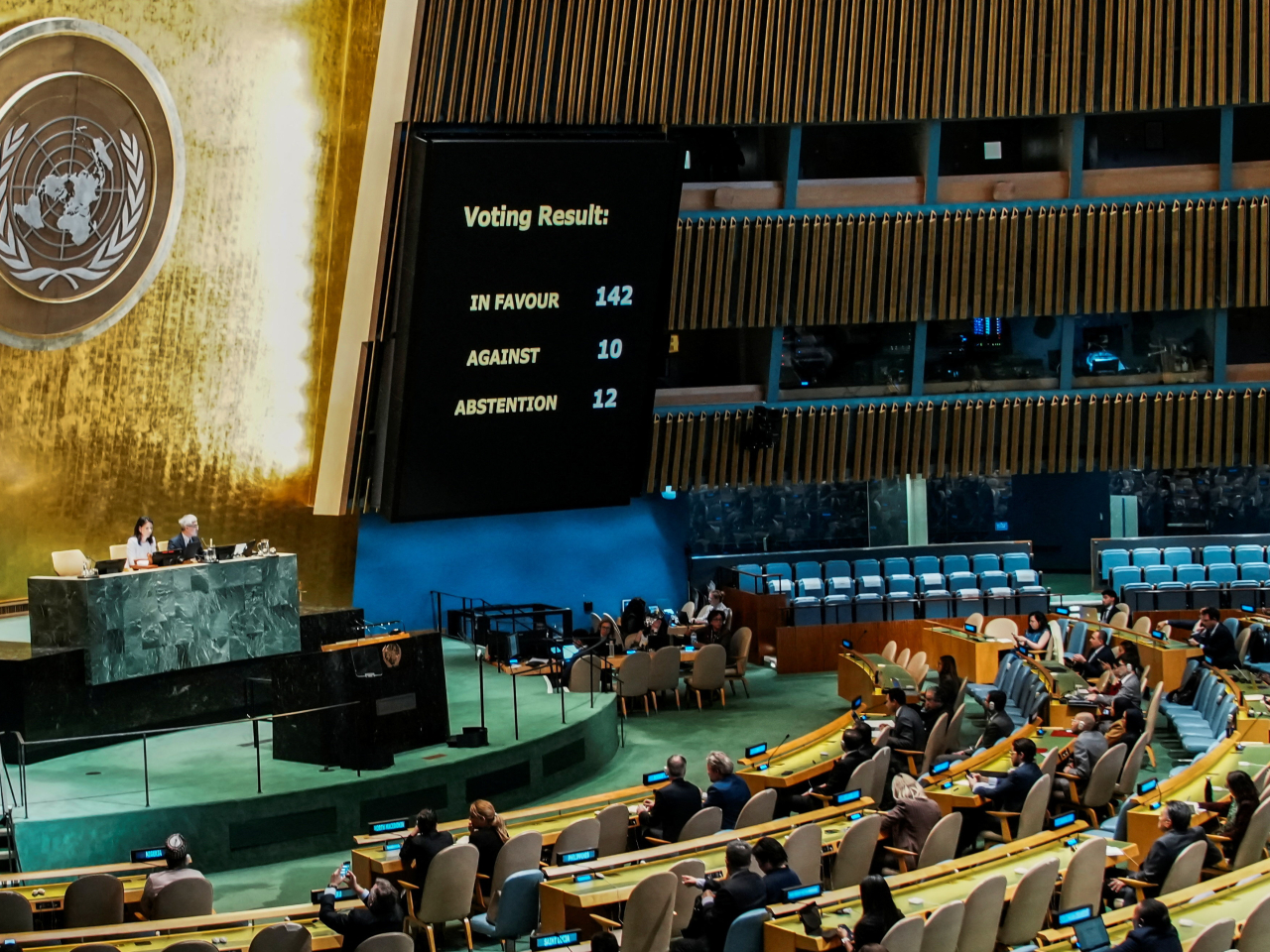
UNITED NATIONS — The U.N. General Assembly overwhelmingly adopted a resolution Friday aimed at reviving the long-stalled two-state solution to the Israeli-Palestinian conflict, explicitly condemning Hamas and demanding the militant group surrender its weapons and relinquish control of Gaza.
The measure, dubbed the New York Declaration on the Peaceful Settlement of the Question of Palestine and the Implementation of the Two-State Solution, passed with 142 votes in favor, 10 against — including Israel and its chief ally, the United States — and 12 abstentions. Presented jointly by France and Saudi Arabia, it marks a rare direct rebuke of Hamas by the assembly, which Israel has accused for nearly two years of failing to condemn the group’s deadly Oct. 7, 2023, attacks.
“Hamas must free all hostages,” the declaration states, while condemning “the attacks committed by Hamas against civilians on the 7th of October.” It calls for “collective action to end the war in Gaza” and achieve a “just, peaceful and lasting settlement” based on two states living side by side.
The text goes further, insisting that Hamas “end its rule in Gaza and hand over its weapons to the Palestinian Authority, with international engagement and support,” aligning with the goal of a sovereign Palestinian state. It also floats the idea of deploying a “temporary international stabilization mission” to the war-torn region under U.N. Security Council mandate to aid civilians.
Already endorsed by the Arab League and co-signed in July by 17 U.N. member states, including several Arab nations, the declaration sets the stage for a high-level summit co-chaired by Saudi Arabia and France on Sept. 22 in New York. French President Emmanuel Macron has pledged to formally recognize a Palestinian state during the event, with several other leaders expected to follow suit — moves intended to ramp up pressure on Israel to halt the Gaza conflict.
Palestinian Vice President Hussein al-Sheikh hailed the vote as an “important step towards ending the occupation and achieving our independent state,” saying it reflects “international willingness to support our people’s rights.”
Israel, however, swiftly rejected the measure. Foreign Ministry spokesman Oren Marmorstein posted on X that the country “utterly rejects” the declaration, branding the General Assembly a “political circus detached from reality.”
The vote comes amid escalating fears that a viable Palestinian state may soon be unattainable. Two years of war have devastated Gaza, while Israeli settlements in the West Bank have expanded, and officials have openly discussed annexation. Israeli Prime Minister Benjamin Netanyahu doubled down Thursday, vowing, “We are going to fulfill our promise that there will be no Palestinian state.”
Adding to the tension, Palestinian President Mahmoud Abbas may be barred from attending the upcoming summit after U.S. authorities indicated they would deny him a visa.
Richard Gowan, U.N. director at the International Crisis Group, told The Associated Press the assembly’s direct condemnation of Hamas is “significant,” even if Israelis view it as “far too little, far too late.” He added that it provides “states supporting the Palestinians” a way to counter Israeli claims of implicitly condoning the group, offering “a shield against Israeli criticism.”
About three-quarters of the U.N.’s 193 member states already recognize the Palestinian state proclaimed in 1988. But the ongoing violence, triggered by Hamas’ Oct. 7 attacks that killed around 1,200 people and led to the abduction of some 250 hostages, has left Gaza in ruins and deepened the divide.
The declaration’s push to sideline Hamas entirely underscores a broader international effort to isolate the group and bolster the Palestinian Authority, though its nonbinding nature limits its immediate impact. Still, as world leaders gather in New York next week, the measure signals a renewed diplomatic offensive to salvage the two-state vision amid one of the region’s most intractable crises.