







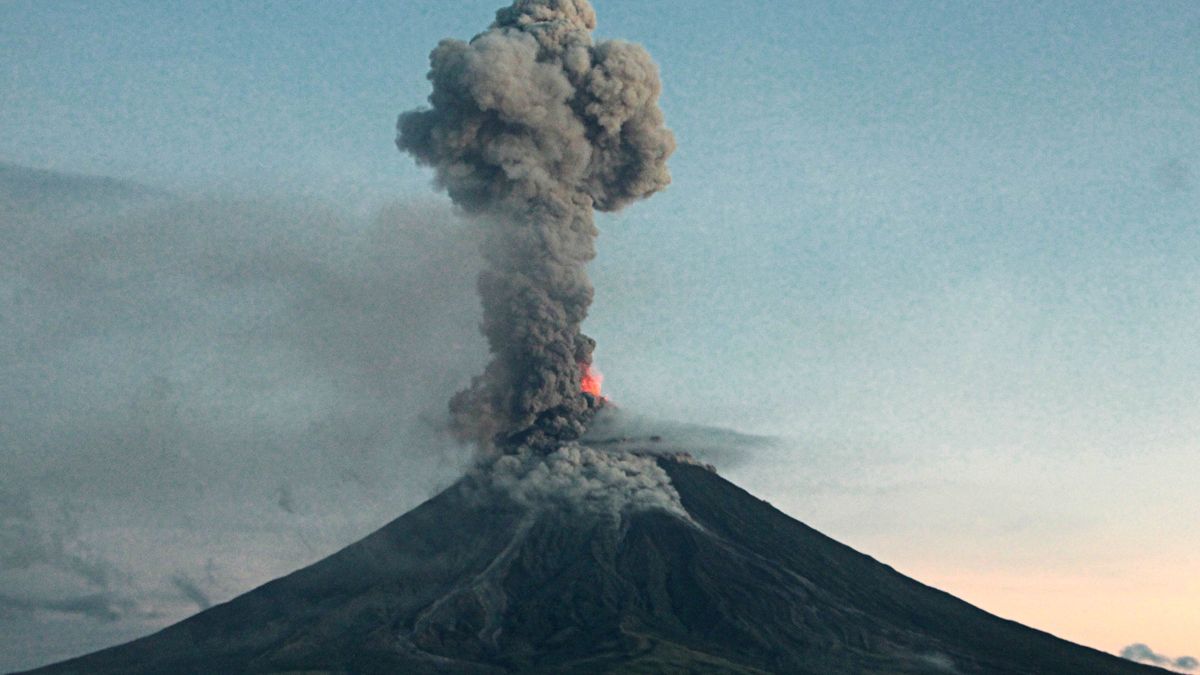
The Mayon Volcano erupted with explosive force on Saturday, triggering a massive collapse on its southern slope and sending superheated clouds of ash and gas screaming toward nearby villages.
The eruption, which occurred on May 2, 2026, is the most severe in a series of intensifying activities over the last six months. Authorities reported that a significant portion of the volcano’s southern flank gave way, resulting in a pyroclastic flow that traveled approximately 4 kilometers (2.5 miles) from the crater [00:00:38].
“This is the latest in a string of eruptions that have been getting bigger and bigger,” said geophysicist Stefan Burns, noting that the stratovolcano’s “sticky” magma allows pressure to build to dangerous levels [00:00:07].
Impact on Local Communities Darkness fell over the Albay province as ash rained down on numerous local villages [00:00:46]. Footage released by the Philippine Institute of Volcanology and Seismology (PHIVOLCS) showed the rapid descent of the pyroclastic flow—a “wall of superheated air and ash” that moves with gravity-driven speed similar to water, but with the potential to “weld” objects in its path [00:03:31].
Social media images from the area showed a landscape blanketed in grey soot as residents braced for further activity during the night [00:02:33].
Increasing Volcanic Activity Satellite data from the MIROVA system indicates that Mayon remained relatively quiet until early 2026. Since February, the volcano has shown a sharp spike in high-heat activity [00:04:47]. Experts warn that the escalating scale of these events—moving from minor steam-driven activity to slope collapses—could be a precursor to a much larger eruption.
While a catastrophic VEI-6 eruption remains statistically unlikely, scientists are monitoring the situation closely. An eruption of that magnitude could potentially inject enough ash into the atmosphere to cause a “volcanic winter,” impacting global temperatures [00:05:35].
A History of Danger Mayon is renowned for its near-perfect conical shape but remains one of the most active and dangerous volcanoes in the Philippines, located along the seismically volatile Pacific Ring of Fire [00:01:05].
Local officials have urged residents to stay clear of the 6-kilometer permanent danger zone as the volcano remains in a state of high unrest. There were no immediate reports of casualties following Saturday’s flank collapse, but search and rescue teams remain on standby.