

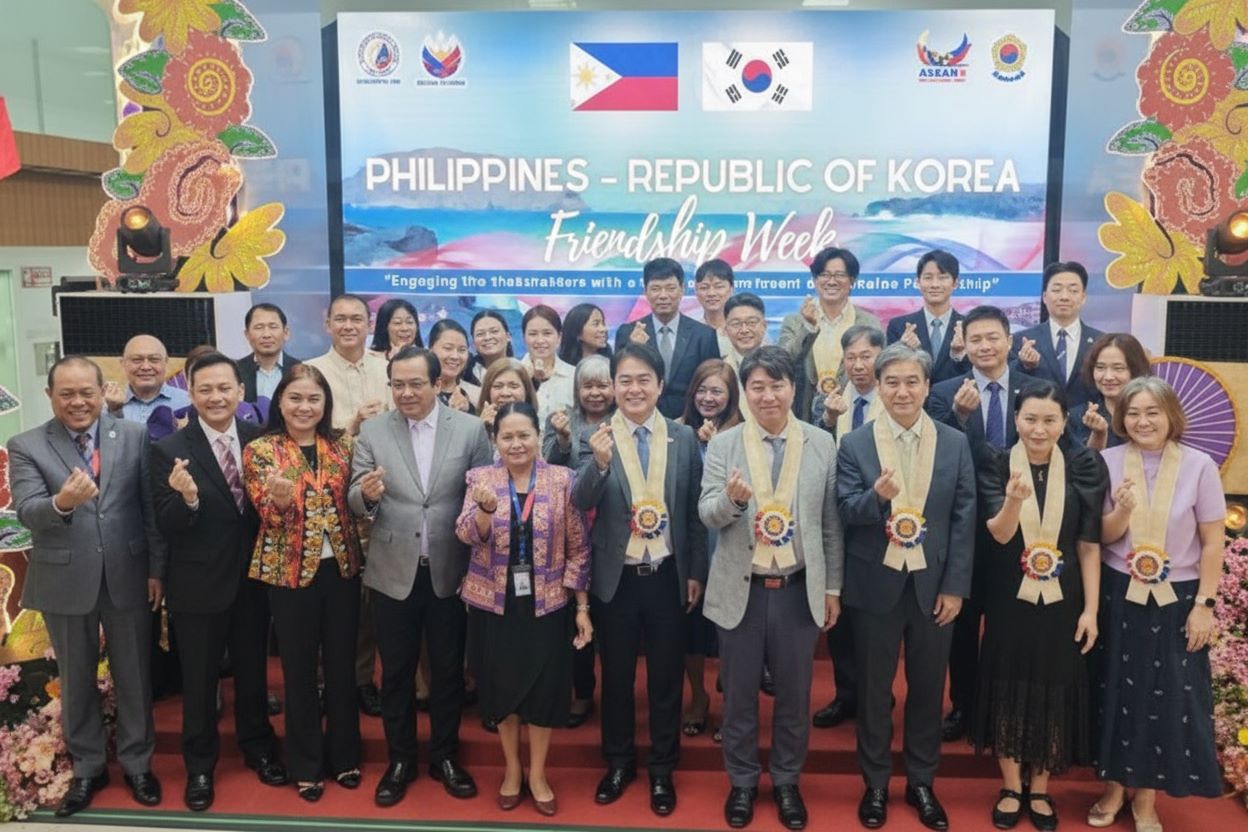
MANILA – The Philippines and South Korea on Tuesday pledged to strengthen protections for overseas Filipino workers while deepening labor and bilateral cooperation, as the two countries marked 77 years of diplomatic ties during the Philippine–Republic of Korea Friendship Week in Mandaluyong City.
Migrant Workers Secretary Hans Leo Cacdac, in a video message read at the event hosted by the Department of Migrant Workers (DMW), highlighted the human stories behind labor migration and cultural exchange between Filipinos and Koreans. “As captured in the book bio, Stories of Migration, these remind us that beyond policies and programs are real people, real journeys, real relationships, and shared dreams and aspirations,” he said.
Cacdac added that Manila and Seoul would continue strengthening their collaboration in advancing the welfare and protection of Filipino migrant workers as well as promoting harmonious relations with Korean employers. Several DMW and Overseas Workers Welfare Administration (OWWA) officials did not attend the celebration in person, as they were participating in a Senate inquiry on the situation of OFWs in the Middle East conflict.
South Korean Ambassador to the Philippines Lee Sang‑hwa stressed that people‑to‑people exchanges remain central to the bilateral partnership. He said the Friendship Week coincided with a recent state visit to the Philippines by South Korean President Lee Jae‑Myung, who met with President Ferdinand R. Marcos Jr. to discuss bilateral investment and trade, both of which he described as progressing “encouragingly.”
“And the most important driving force has been the vibrant exchange between the peoples of our two countries,” Lee said, noting that behind economic achievements lies the contribution of workers, including Filipinos in South Korea. He recalled a meeting during the visit between President Lee and Ariel Galak, a former OFW who had worked in a South Korean factory in 1992 and suffered a workplace accident.
Lee explained that President Lee, then a young human rights‑lawyer, had helped Galak secure industrial accident compensation after he returned to the Philippines without proper redress. “Their recent meeting was a powerful reminder of our President’s longstanding and heartfelt concern for the human rights, workplace safety, and occupational health of all workers, both Korean and foreign,” he said.
Since 2004, more than 100,000 Filipinos have entered South Korea through the Employment Permit System (EPS), South Korea’s bilateral labor program with the Philippines and several other countries. Ambassador Lee described them as “true goodwill ambassadors” of Philippine–South Korea relations.
Philippine Ambassador to Seoul Bernadette Therese Fernandez, delivering a message at the event, said both governments were working to address shortfalls in worker‑protection mechanisms, acknowledging that “it is not a perfect system.” She vowed that the Philippine Embassy in Seoul and relevant agencies “will not permit” unintended circumstances or abuses to continue.
“Manila and Seoul will pursue stronger cooperation to improve conditions for every Filipino worker in South Korea,” she said.
DMW Undersecretary Felicitas Bay underscored the department’s commitment to safeguarding the rights, welfare, and dignity of OFWs. She noted that the Philippines–South Korea partnership extended beyond labor cooperation to include education, innovation, cultural exchange, and economic development.
“As we celebrate Philippine–Korea Friendship Week, we reaffirm our collective commitment to nurturing a partnership that continues to promote prosperity, dignity for workers, and a deeper understanding between our people,” Bay said, adding that OFWs serve as living bridges of friendship between Filipinos and Koreans through their professionalism, resilience, and hard work.