




The Middle East has long been the “Land of Promise” for millions of Filipinos, but as of March 2026, the promise is being tested by the shadows of a widening regional conflict. With tensions between the Iranian regime and the US-Israel alliance escalating into direct strikes, our modern-day heroes find themselves on the front lines of a geopolitical chess match.
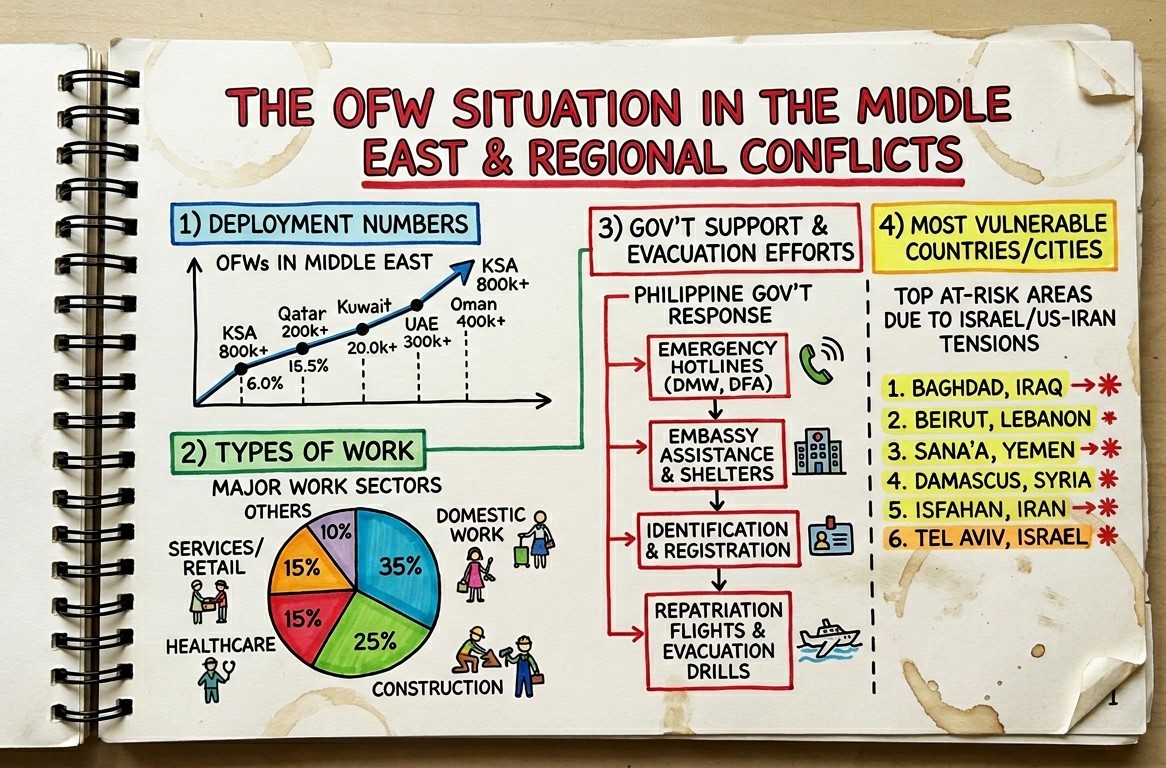
Below is a detailed breakdown of the current OFW landscape, accompanying our latest infographic on the crisis.
1. The Numbers: A Million Lives in the Balance
The infographic highlights a massive concentration of Filipino talent across the Gulf. Despite the volatility, the sheer volume of our workforce remains staggering.
- Saudi Arabia (KSA): Still the primary destination, hosting over 800,000 OFWs.
- Oman & UAE: Combined, these nations support nearly 700,000 Filipinos.
- Qatar & Kuwait: Home to over 220,000 workers.
While these numbers represent economic stability for families back home, they now represent a logistical challenge for the Department of Migrant Workers (DMW). Most of these workers are located in urban hubs—the very places increasingly vulnerable to drone and missile interceptions.
2. Sectoral Breakdown: The Backbone of the Middle East
Filipinos aren’t just “there”; they are the engine room of these economies. The infographic reveals a diverse sectoral spread:
| Sector | Percentage | The Reality |
| Domestic Work | 35% | Often the most vulnerable due to isolation in private homes during emergencies. |
| Construction | 25% | Essential for the region’s infrastructure but often located near industrial targets. |
| Healthcare | 15% | Our “Frontline’s Frontline,” keeping hospitals running even under fire. |
| Services | 15% | The face of the Gulf’s retail and hospitality industries. |
| Others | 10% | Specialized technical and professional roles. |
3. The Red Zones: Where the Danger is Highest
Geopolitics isn’t just about maps; it’s about neighborhoods. Based on current military activity and the Iranian-Israeli engagement, the following cities are ranked as the most high-risk for our kababayans:
- Baghdad, Iraq: Historically volatile, now a frequent site for proxy skirmishes.
- Beirut, Lebanon: Currently under Alert Level 3; facing intense aerial bombardments.
- Sana’a, Yemen: Caught in the crossfire of Houthi-related retaliatory strikes.
- Damascus, Syria: A long-standing “red zone” with frequent targeted strikes.
- Isfahan, Iran: A central hub for the Iranian regime’s strategic assets, making it a primary target for Israeli response.
- Tel Aviv, Israel: Facing consistent rocket fire and drone incursions.
4. The Shield: Government Support & Evacuation
The Philippine government has activated a “Whole-of-Nation” approach to ensure no one is left behind. As seen in the infographic, the response follows a structured 4-step protocol:
- Phase 1: 24/7 Hotlines & Digital Monitoring
The DMW and DFA have expanded the 1348 hotline and the e-Report platform. Real-time monitoring allows the government to track the safety of OFWs in strike-affected areas. - Phase 2: Temporary Shelters (MWO-OWWA)
For those displaced or whose workplaces have been hit, Migrant Workers Offices (MWO) have established safe havens. These provide food, water, and medical care. - Phase 3: Registration & Profiling
Essential for organized evacuation. The government is prioritizing the “vulnerable of the vulnerable”—undocumented workers, the elderly, and those with medical conditions. - Phase 4: Repatriation Efforts
With airspaces in Kuwait, Qatar, and Bahrain facing periodic closures, the government is utilizing “Land-Bridge” evacuations to Riyadh and chartered flights out of the UAE (Dubai), which remains a critical transit hub.
A Note of Resilience: While the situation is grave, the spirit of the OFW remains unbroken. The Philippine government is currently managing the return of thousands, ensuring that those who choose to leave are welcomed home with financial assistance and reintegration programs.
A list of the latest emergency contact numbers for each of these high-risk cities
Here is the list of the latest emergency contact numbers for Overseas Filipino Workers (OFWs) in the high-risk areas identified in the current 2026 Middle East crisis. These numbers are active for 24/7 “Assistance to Nationals” (ATN) and labor-related emergencies.
🚨 Emergency Contact Directory (March 2026)
🇮🇱 Tel Aviv, Israel
- 24/7 Emergency Hotline (Calls/WhatsApp/Viber): +972 54 466 1188
- Migrant Workers Office (MWO): +972 50 762 2590
- OWWA Welfare Office: +972 50 715 6937
- Email: telaviv.pe@dfa.gov.ph
🇱🇧 Beirut, Lebanon
- Emergency ATN Hotline: +961 70 858 086
- Migrant Workers Office (MWO): +961 79 110 729
- OWWA Hotline: +961 76 681 603
- Email: beirut.pe@dfa.gov.ph
🇮🇷 Tehran & Isfahan, Iran
- Emergency ATN Hotline (Calls/WhatsApp): +98 912 213 6801
- Consular Hotline: +98 912 105 5637
- Email: tehran.pe@dfa.gov.ph
🇮🇶 Baghdad, Iraq
- Emergency ATN Hotline: +964 783 700 5457
- Main Trunkline: +964 782 881 1037
- Email: baghdad.pe@dfa.gov.ph
🇸🇾 Damascus, Syria
- Emergency ATN Hotline: +963 949 155 567
- Consular Services: +963 949 155 557
- Main Office: +963 11 613 2626
- Email: damascus.pe@dfa.gov.ph
🇾🇪 Sana’a, Yemen
(Note: Assistance is largely coordinated through the Philippine Embassy in Riyadh)
- Honorary Consulate (Sana’a): +967 1 425 277 / +967 1 416 751
- Email: sanaa@philembassy_riyadh.org
🌎 Global Support (Philippines-Based)
If local lines are down due to infrastructure damage, families in the Philippines or OFWs can use these centralized numbers:
- OWWA International Hotline: (+632) 1348
- DMW “One Repat” Command Center: +63 2 8722 1144 / +63 2 8722 1155
- OWWA WhatsApp Support: +63 956 319 7589 / +63 968 694 0706
Pro-Tip for OFWs: Always keep your Philippine passport and work permits in a “Go-Bag” near your exit. If you are in a strike zone, join the official WhatsApp/Viber groups managed by your respective embassies for real-time evacuation coordination.