






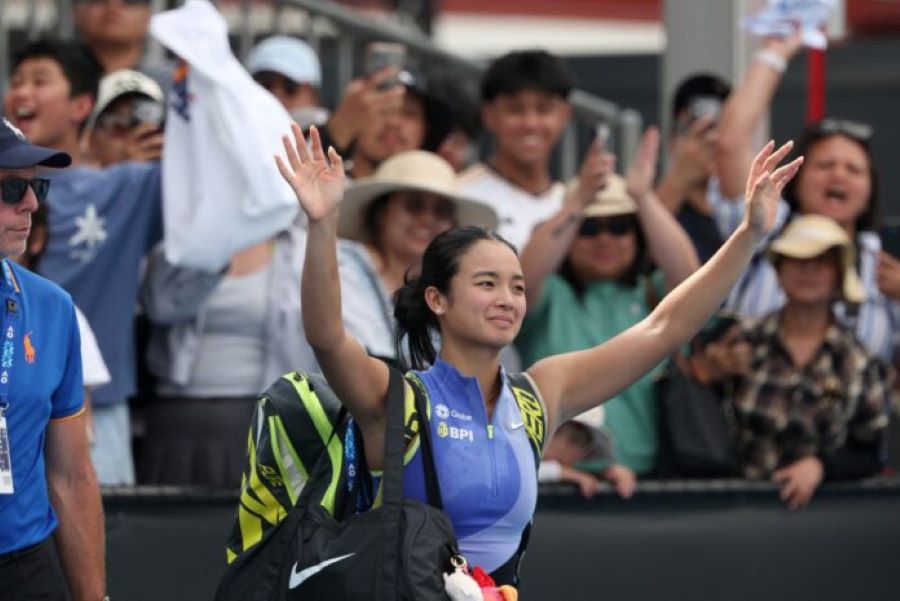
In the rigid, high-walled ecosystem of professional tennis, power has traditionally been a meritocracy governed by the “old guard.” You climb the rankings, you survive the back courts, and eventually, if you’re lucky, you earn a seat at the table with the likes of Novak Djokovic and Carlos Alcaraz. But in Melbourne, 20-year-old Alex Eala didn’t wait for an invitation. She simply brought the table with her.
Eala’s debut at the Australian Open has become a definitive case study in the democratization of stardom. Without a Grand Slam title to her name, this young disruptor from the Philippines commanded a level of gravity that left tournament organizers and seasoned champions scrambling to keep up. It wasn’t just a debut; it was a market-shifting event that proved the traditional architecture of tennis greatness is being dismantled by a new metric: connection-first influence.
The Algorithm vs. The Ace: Why 170,000 People Watched a Press Conference
The digital footprint of Eala’s Melbourne run is nothing short of a statistical anomaly. In a sport where viewership usually tracks with seedings, Eala’s pre-tournament press conference pulled in over 170,000 views. To grasp the scale of that “digital popularity paradox,” look at the gatekeepers: those numbers dwarf the press engagement of world number ones and reigning champions like Djokovic, Aryna Sabalenka, and Alcaraz.
This isn’t just about social media clout; it’s about a broadcast-ready presence that exists independently of a trophy case. For the modern sports analyst, this signals a shift where national identity and personality are no longer secondary to technical stats, they are the primary engines of the business.
“People come out for their stars.” — Andy Roddick, Served Podcast
The Court 6 Spectacle: A Logistics Nightmare
The “Eala Effect” wasn’t limited to a viral algorithm; it physically strained the infrastructure of Melbourne Park. Scheduled for Court 6, a venue typically reserved for the quiet hum of lower-tier matches, Eala’s debut was instead greeted by a wave of unapologetic national pride. Fans arrived hours early, transforming the cramped bleachers into a sea of Philippine flags and rhythmic chanting.
Senior organizer Michael Jung later admitted that the tournament had severely underestimated Eala’s draw. Her match generated nearly 20 times the media attention of reigning Grand Slam champions playing on nearby courts. This wasn’t a case of disruptive fan misconduct; it was a seismic shift in atmosphere. Alysia Parks, Eala’s opponent, saw firsthand how this support “tilted the atmosphere,” proving that Eala’s celebrity isn’t just a marketing tool, it’s a competitive variable that can affect outcomes in high-pressure matches.
Structural Overhaul: The Navratilova/Roddick Mandate
The chaos at Court 6 caught the attention of the sport’s legendary “old guard,” who recognized that the game’s scheduling logic is fundamentally broken. Martina Navratilova isn’t just watching Eala; she’s calling for a structural overhaul. Navratilova argued that tournaments like the Australian Open must proactively “anticipate player popularity” rather than reacting to it, suggesting that Eala’s massive following deserved a venue that reflected her reality, not her current ranking.
“She is the biggest we have ever seen.” — Novak Djokovic, during an interview
This creates a fascinating tension: Should a tournament prioritize “skill-based ranking” or “star power”? Andy Roddick has joined the chorus, noting that Eala’s popularity is a tangible force that organizers and coaches can no longer ignore. The game is evolving, and the “Eala Effect” is the catalyst forcing the hand of tournament directors who are used to a more predictable hierarchy.
Commercial Gravity and the Humility Paradox
From a commercial perspective, Eala is a unicorn. Sponsors are increasingly noticing that engagement metrics often outweigh rankings when it comes to marketability. In the new economy of tennis, the ability to inspire a nation is a commodity that rivals a trophy in the cabinet.
Yet, there is a compelling narrative tension within Eala herself. Despite the deafening hype, she remains remarkably grounded, telling reporters she is “nowhere near the leagues of the greats.” This “humility paradox”—the contrast between an athlete who views herself as a work in progress and a fanbase that treats her like a deity—only adds to her allure. She is currently walking a tightrope, balancing the massive external visibility of a national icon with the internal pressure to perform.
The Fan as the Catalyst for Tennis Evolution
Ultimately, Alex Eala is the vessel, but her fans are the disruptors. The Filipino community didn’t just come to watch; they came to make a historical statement. By filling the stands and celebrating every point as if it carried the hopes of an entire nation, they proved that passion and representation are forces that the tennis world can no longer sideline.
This wasn’t about chaos or entitlement, it was sports at its most electrifying. As the global media and commentators took notice, the message was clear: Sometimes it’s not the players who redefine the sport; it’s the fans whose energy demands a change in the model.
Conclusion: A New Era for the Game
Alex Eala has provided the blueprint for the modern tennis star. Her Australian Open debut proves that in the 21st century, influence can grow alongside skill, rather than simply trailing behind it. She has leveraged connection, personality, and a powerful sense of national identity to force the “old guard” to reconsider how they value talent.
As the sport moves forward, we have to ask if the establishment is ready to fully lean into this fan-driven popularity. But for the young star at the center of the storm, a more personal question remains: Can Alex Eala turn this massive attention into Grand Slam success, or is the pressure of a nation’s hopes too much for one young star to carry?