









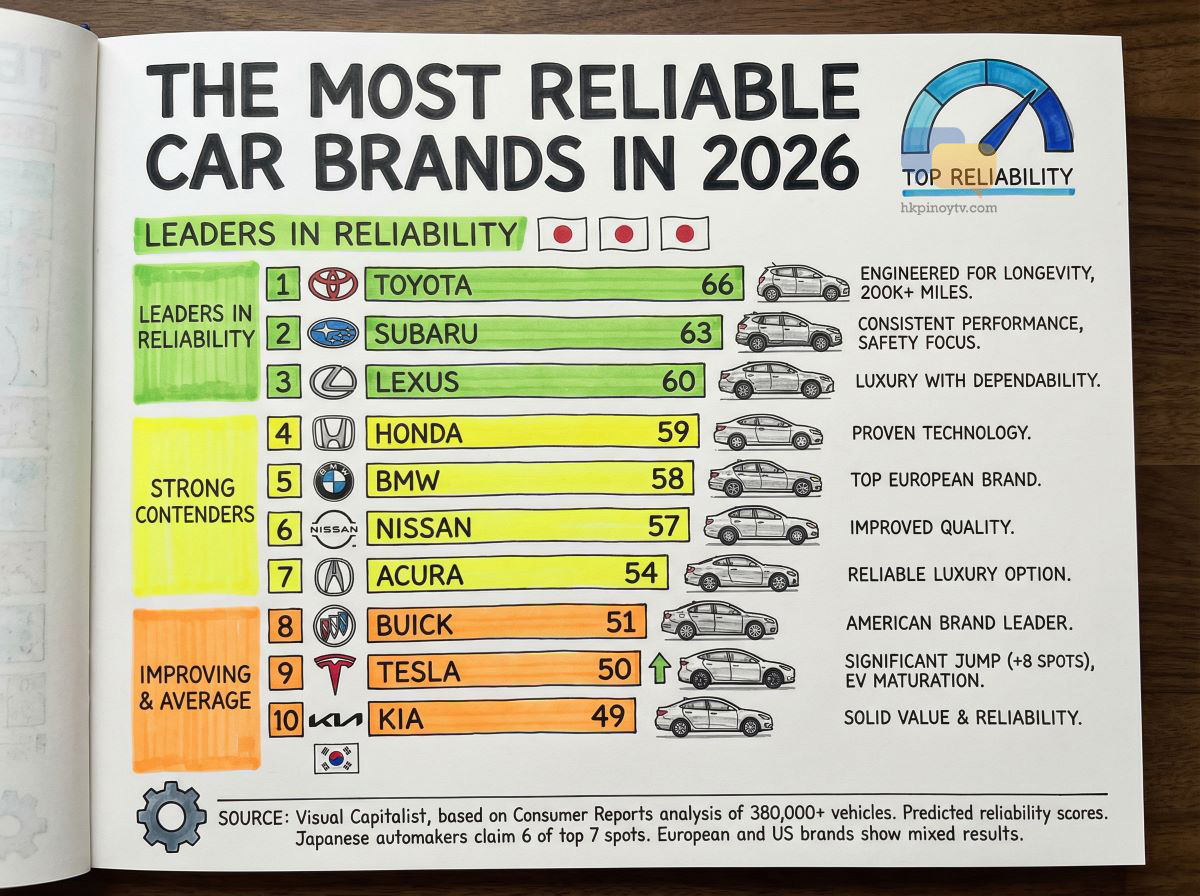
Japanese automakers continue to dominate the automotive landscape, securing six of the top seven spots in Consumer Reports’ 2026 annual reliability rankings, while Tesla recorded a significant jump as electric vehicle technology begins to mature.
The rankings, released Monday, are based on a massive data set of self-reported owner experiences covering approximately 380,000 vehicles. The survey allows the nonprofit organization to predict the reliability of nearly every new car, truck, and SUV on the market.
Toyota claimed the top position this year with a reliability score of 66, followed closely by Subaru and Lexus. Industry analysts attribute the consistent performance of Japanese brands to a philosophy of conservative engineering and a reliance on proven technology rather than frequent, radical redesigns.
“Toyota, Subaru, and Lexus topping the 2026 rankings reinforces Japan’s long-standing reputation for vehicle reliability,” the report noted. The study highlighted that Toyota’s focus on simplified powertrain designs and rigorous quality control often results in vehicles capable of exceeding 200,000 miles with standard maintenance.
Honda and Nissan also posted strong results, further cementing the region’s grip on the top of the leaderboard.
While Japanese brands held the lead, Tesla emerged as the year’s biggest mover. The Texas-based electric vehicle manufacturer climbed eight spots to ninth place, its highest ranking in recent years. The improvement was driven by the Model 3 and Model Y, which Consumer Reports says are now benefiting from years of incremental design refinements.
The shift suggests that as EV models stay in production longer, manufacturers are successfully ironed out the software glitches and hardware “teething” issues that have historically plagued the segment.
European brands saw a wide disparity in performance. BMW distinguished itself as the top-performing European automaker, ranking fifth overall and beating out several Japanese rivals. However, other major luxury players struggled to keep pace; Volkswagen, Audi, Mercedes-Benz, and Volvo all clustered in the middle of the pack with scores in the low-to-mid 40s.
Consumer Reports uses the aggregated data to compare different powertrains, noting that the complexity of plug-in hybrids and the relative novelty of some fully electric models continue to create a reliability gap compared to traditional internal combustion engines and standard hybrids.
The annual survey is considered a benchmark for the industry, often influencing consumer buying habits and forcing manufacturers to address recurring mechanical or technological failures.