







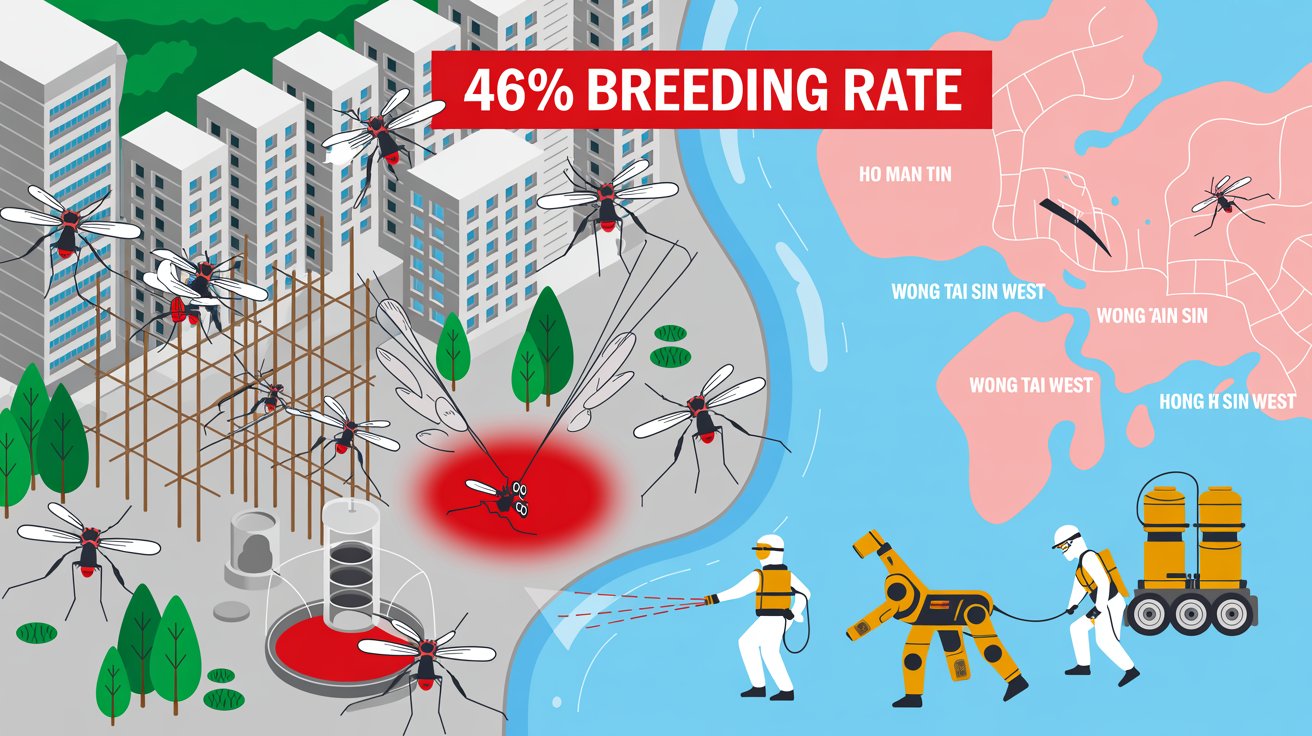
Hong Kong health authorities said Thursday they are intensifying efforts to combat mosquitoes after breeding rates surged to “extensive” levels across multiple districts, with the Tai Wai neighborhood recording the highest infestation rate in the latest government survey.
The Food and Environmental Hygiene Department announced expanded enforcement operations after releasing results showing six of 19 monitored areas had Gravidtrap Index readings exceeding 20 percent — the threshold authorities use to classify mosquito distribution as “extensive” and warranting public alerts.
Tai Wai, a residential district in Sha Tin, recorded the highest breeding rate at 46 percent. Other affected areas included Ho Man Tin, Yau Tong and Cha Kwo Ling, Lam Tin and Sau Mau Ping, Wong Tai Sin West, and Ma Wan and Sham Tseng.
Senior superintendent Hung Sai-kit told public broadcaster RTHK that current levels were broadly comparable to historical norms, suggesting last year’s relatively lower rates may have been linked to reduced rainfall.
“We found there were some plots or housing compounds with mosquito breeding sites, and so we immediately took enforcement action,” Hung said, adding that officials had inspected private housing estates, schools and parks. Authorities have been issuing notices to property management companies requiring them to drain standing water.
Officials are also deploying new technologies in the fight, including large industrial sprayers and robotic dogs to access hard-to-reach areas.
Sha Tin West district councillor Chan Tan-tan attributed Tai Wai’s spike partly to a surge in local construction activity. Standing water accumulates in bamboo scaffolding baskets and holes in roadside barriers, she said, creating overlooked breeding grounds.
“We have received reports not only from ordinary citizens but also construction workers, saying that there are really a lot of mosquitoes,” Chan said.
She called on authorities to adopt more advanced tools such as drones and artificial intelligence-equipped devices, pointing to their use in Singapore and parts of China’s Greater Bay Area as models worth emulating.
Hung noted that mosquito activity in Hong Kong typically peaks between April and May before tapering off in September.