








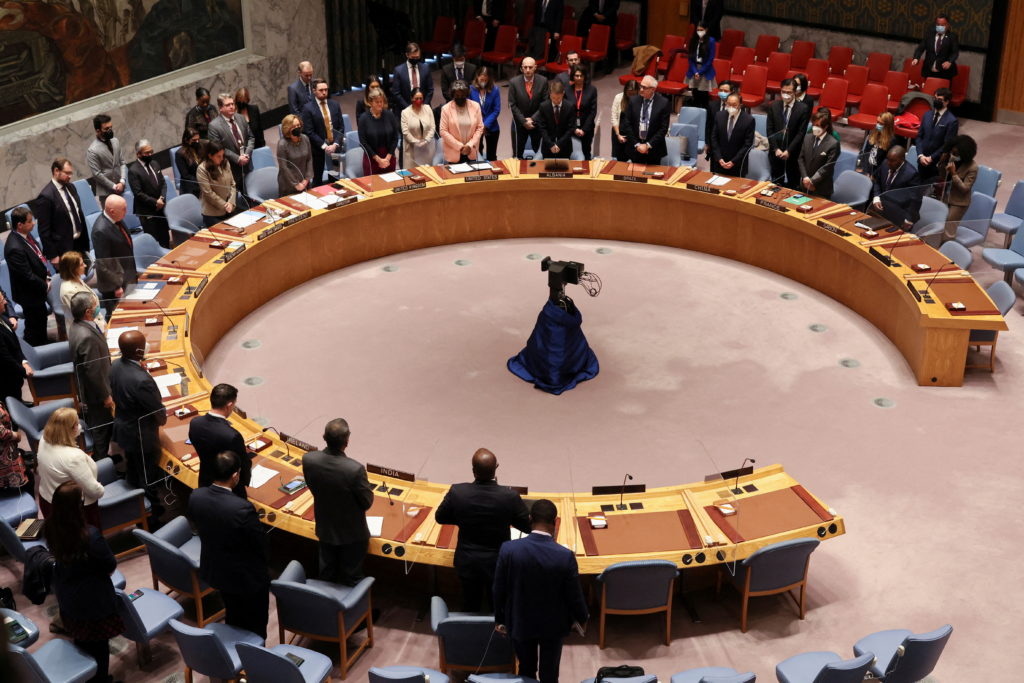
UNITED NATIONS — The United Nations Security Council is set to convene Sunday to address the recent U.S. military strikes on Iran’s nuclear sites, a move that has escalated tensions in the Middle East and prompted a sharp rebuke from Tehran. The emergency meeting, requested by Iran, comes as China, Russia, and Pakistan push for a resolution demanding an immediate and unconditional ceasefire in the region.
The draft resolution, circulated by the three nations, calls on the 15-member body to condemn the U.S. and Israeli actions as a violation of international law. Diplomats said the text was shared with council members, who were asked to provide feedback by Monday evening. It remains unclear when the resolution might be put to a vote.
A resolution requires at least nine votes in favor and no vetoes from the council’s permanent members—China, France, Russia, the United Kingdom, or the United States—to pass. Given the U.S. involvement in the strikes, a veto from Washington is widely anticipated.
The strikes, which President Donald Trump described as having “obliterated” Iran’s key nuclear facilities, were conducted in coordination with Israel, marking a significant escalation in the long-standing rivalry between Israel and Iran. The operation follows heightened regional tensions, with Israel and Iran engaged in a series of tit-for-tat attacks in recent months.
Iran, in its request for the Security Council meeting, denounced the strikes as a “blatant and unlawful act of aggression” and urged the council to issue a strong condemnation. Tehran’s ambassador to the UN emphasized the need for accountability, accusing the U.S. and Israel of undermining global stability.
In response, Israel’s UN Ambassador Danny Danon defended the strikes, arguing that the U.S. and Israel “do not deserve any condemnation, but rather an expression of appreciation and gratitude for making the world a safer place.” Danon’s statement underscored Israel’s position that the strikes were a necessary measure to curb Iran’s nuclear ambitions.
The international community remains on edge as Iran has yet to outline its response to the strikes. Analysts warn that any retaliation could further destabilize the region, already strained by ongoing conflicts and diplomatic rifts.
The Security Council’s meeting is expected to draw intense scrutiny, with global powers divided on how to address the crisis. While China, Russia, and Pakistan advocate for de-escalation, the U.S. and its allies are likely to frame the strikes as a preemptive action against a potential nuclear threat.
As the council prepares to deliberate, the world awaits clarity on whether diplomatic efforts can avert further escalation in a region already fraught with volatility.