








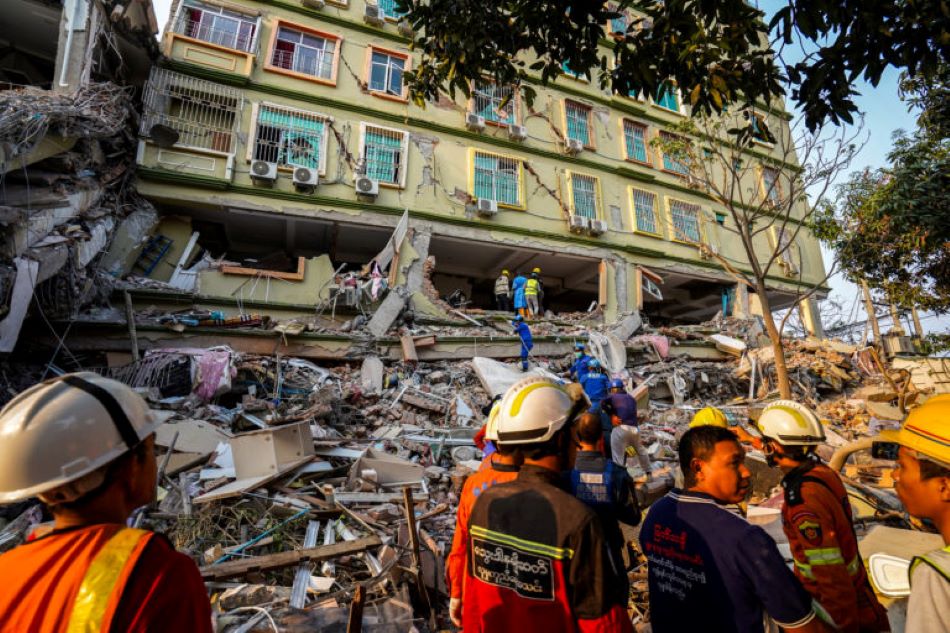
YANGON, Myanmar — As rescue teams and aid pour into Myanmar following a devastating 7.7-magnitude earthquake, the toll continues to climb, with approximately 1,700 confirmed dead, 3,400 injured, and over 300 still missing as of Sunday. This earthquake, one of the strongest to strike the war-torn Southeast Asian nation in a century, hit on Friday, leaving communities scrambling for resources to mount rescue efforts.
Senior General Min Aung Hlaing, head of Myanmar’s military government, warned that the death toll could rise further. He made a rare call for international assistance just days before, acknowledging the challenges his administration faces. Countries including India, China, and Thailand have responded, sending relief materials and teams to assist in the crisis.
“The destruction has been extensive, and humanitarian needs are growing by the hour,” stated the International Federation of Red Cross and Red Crescent Societies. With rising temperatures and the monsoon season approaching, there is an urgent need to stabilize affected communities to prevent secondary crises.
The earthquake has exacerbated the ongoing turmoil in Myanmar, where civil conflict has escalated since the military coup in 2021 ousted the elected government of Nobel laureate Aung San Suu Kyi. Critical infrastructure across the nation—bridges, highways, airports, and railways—has been severely damaged, hampering humanitarian efforts in a country already grappling with an economy in freefall and over 3.5 million displaced individuals.
In areas close to the epicenter, residents have reported a lack of government assistance. “It is necessary to restore the transportation routes as soon as possible,” Min Aung Hlaing said, urging officials to expedite repairs to vital infrastructure to facilitate rescue operations.
Predictive modeling from the U.S. Geological Survey estimates that Myanmar’s death toll could surpass 10,000, with economic losses potentially exceeding the nation’s annual output.
Hospitals Overwhelmed, Aid Scarce
Hospitals in central and northwestern Myanmar, including the second-largest city, Mandalay, and the capital Naypyitaw, are struggling to cope with the influx of injured individuals. The U.N. Office for the Coordination of Humanitarian Affairs reported that medical facilities are overwhelmed, with many unable to treat all patients.
In neighboring Thailand, the quake also caused significant damage, resulting in the collapse of an under-construction skyscraper that claimed 18 lives. Rescue efforts are ongoing there, with at least 76 people still trapped under the rubble.
The opposition National Unity Government, comprised of remnants of the former administration, announced a two-week halt to offensive military actions to facilitate humanitarian efforts in the wake of the disaster.
In the town of Sagaing, near the quake’s epicenter, resident Han Zin reported widespread destruction. “Many buildings have collapsed,” he said, noting that power and drinking water supplies were critically low. “We have received no aid, and there are no rescue workers in sight.”
With major bridges destroyed, aid from Mandalay has been slow to reach affected areas. “Food and medicine are unavailable,” the Sagaing Federal Unit Hluttaw stated on social media, highlighting the dire situation facing local hospitals.
Desperate Search for Survivors
In Mandalay, scores of people are feared trapped under collapsed buildings, with rescue efforts hampered by the need for heavy machinery. Humanitarian workers reported using basic tools to dig for survivors amidst the rubble. “There are countless trapped and still missing,” one worker noted.
A video shared with Reuters showed patients occupying hospital grounds outside a 500-bed orthopedic facility, many receiving treatment in makeshift conditions. Damaged healthcare facilities, including the Mandalay General Hospital, are struggling to meet the overwhelming demand.
As rescuers in Thailand continue their efforts at the site of the collapsed building, relatives of the missing await news with bated breath. “Ploy, Ploy, Ploy, my daughter, I’m here for you now!” one woman cried out, highlighting the personal tragedies unfolding amidst the widespread devastation.
As Myanmar grapples with this dual crisis of natural disaster and ongoing civil strife, the international community watches closely, hoping for a coordinated response that can provide relief to those most affected by this catastrophic event.