







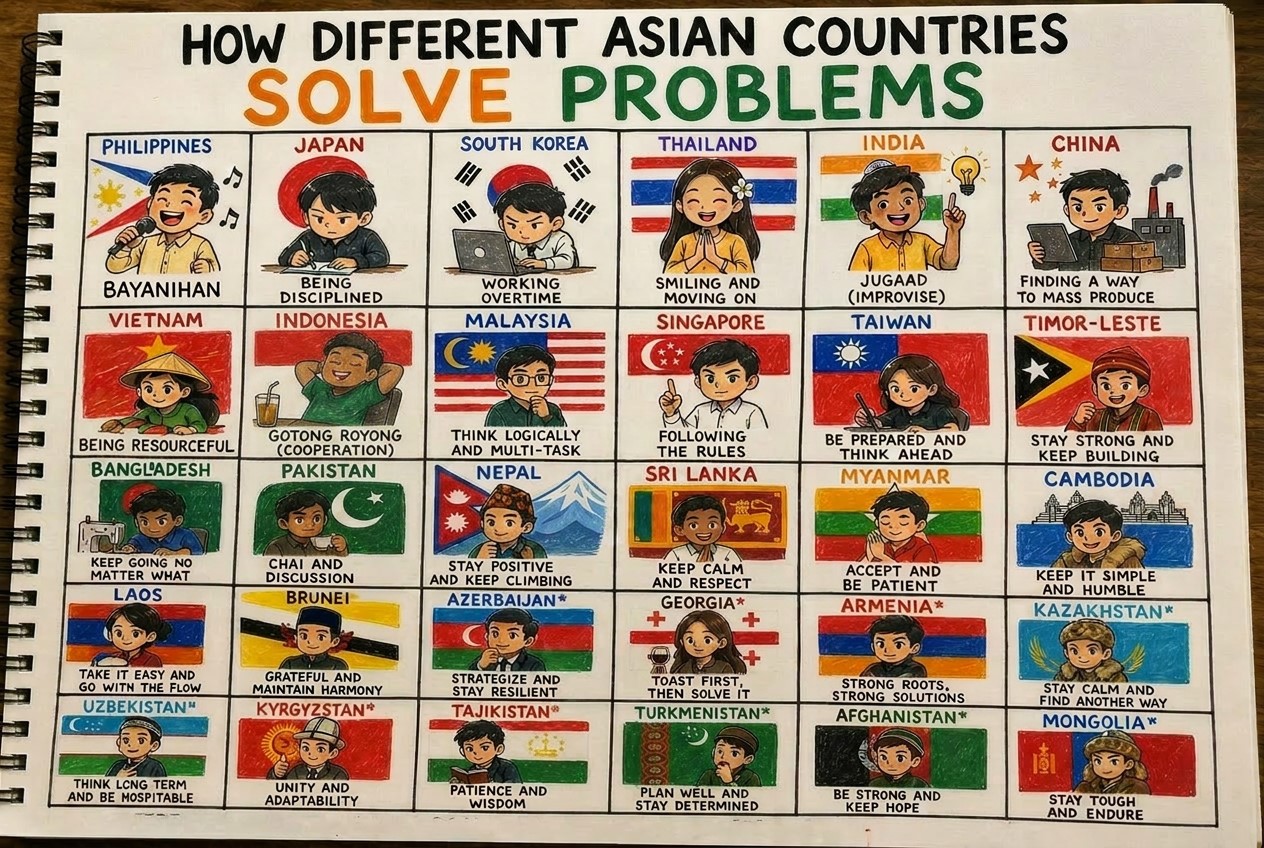
From Bayanihan to Jugaad — the diverse wisdom of Asia
Asia is home to nearly 60% of the world’s population, spanning thousands of cultures, languages, and traditions. Yet one thing unites them all: the need to solve problems. What’s fascinating is how each country approaches challenges — shaped by centuries of history, philosophy, and lived experience. Let’s take a journey across the continent and explore the unique problem-solving spirit of Asian nations.
🇵🇭 Philippines — Bayanihan
In the Philippines, no one faces a problem alone. Bayanihan — derived from the word bayan (community) — is the deeply rooted cultural practice of coming together as a community to help one another. Whether it’s rebuilding after a typhoon or supporting a neighbor in need, Filipinos believe that collective effort makes every burden lighter. It’s not just a strategy; it’s a way of life.
🇯🇵 Japan — Being Disciplined
Japan’s approach to problem-solving is rooted in discipline and precision. The Japanese philosophy of Kaizen (continuous improvement) means that problems are not just fixed — they are systematically prevented. Discipline in process, attention to detail, and a deep respect for structure allow Japan to tackle challenges with quiet, methodical efficiency.
🇰🇷 South Korea — Working Overtime
South Koreans are renowned for their relentless work ethic. The concept of nunchi (reading the room) combined with a culture of dedication means that when a problem arises, South Koreans roll up their sleeves and put in the hours. This drive has transformed a war-torn nation into one of the world’s leading tech and economic powerhouses in just a few decades.
🇹🇭 Thailand — Smiling and Moving On
Thailand’s nickname, “The Land of Smiles,” isn’t just for tourists. Thais approach adversity with grace, positivity, and emotional resilience. Rather than dwelling on setbacks, the Thai cultural value of sanuk (finding joy) encourages people to maintain a positive outlook and keep moving forward — a powerful form of emotional intelligence in the face of hardship.
🇮🇳 India — Jugaad (Improvise)
Perhaps one of the most celebrated problem-solving philosophies in the world, Jugaad is the Indian art of frugal innovation — finding a quick, ingenious fix with whatever resources are available. From low-cost medical devices to creative engineering hacks, Jugaad embodies the spirit of doing more with less. It’s entrepreneurship born out of necessity, and it’s reshaping global innovation thinking.
🇨🇳 China — Finding a Way to Mass Produce
China’s answer to problems is often scale. With an unmatched manufacturing ecosystem and a culture of pragmatic execution, China has mastered the art of taking a solution and deploying it at extraordinary speed and volume. This approach has made China the world’s factory — and increasingly, its innovation hub.
🇻🇳 Vietnam — Being Resourceful
Vietnam’s history of resilience has forged a culture of resourcefulness. Vietnamese people are known for finding creative solutions under pressure, making the most of limited resources, and adapting quickly to changing circumstances. It’s a mindset born from decades of rebuilding — and it continues to fuel one of Southeast Asia’s fastest-growing economies.
🇮🇩 Indonesia — Gotong Royong (Cooperation)
Much like the Philippines, Indonesia’s problem-solving DNA is communal. Gotong Royong — meaning mutual cooperation — is a national philosophy enshrined in Indonesian culture. Whether tackling local infrastructure challenges or national crises, Indonesians lean on collective action, shared responsibility, and community solidarity.
🇲🇾 Malaysia — Think Logically and Multi-Task
Malaysians bring a pragmatic, analytical mindset to problem-solving, combined with an impressive ability to juggle multiple priorities at once. In a multicultural society that blends Malay, Chinese, Indian, and indigenous influences, the ability to think across perspectives and manage complexity is a natural strength.
🇸🇬 Singapore — Following the Rules
Singapore’s remarkable transformation from a third-world port to a first-world city-state is largely attributed to strong governance and rule of law. Singaporeans solve problems by trusting in well-designed systems, following established processes, and holding institutions accountable. It’s proof that structure and discipline, when applied wisely, can produce extraordinary results.
🇹🇼 Taiwan — Be Prepared and Think Ahead
Taiwan’s approach is defined by strategic foresight. Whether in semiconductor manufacturing or disaster preparedness, Taiwanese culture values anticipating problems before they arise. This forward-thinking mindset has made Taiwan a global leader in technology and a model of crisis management.
🇳🇵 Nepal — Stay Positive and Keep Climbing
Quite literally a nation of climbers, Nepal’s problem-solving spirit is one of perseverance and optimism. Faced with geographic isolation, natural disasters, and economic challenges, Nepalis embody the mountaineer’s creed: keep your head up, take the next step, and trust that the summit is within reach.
🇵🇰 Pakistan — Chai and Discussion
In Pakistan, many of the world’s greatest problems have been solved — or at least thoroughly analyzed — over a cup of chai. The culture of open dialogue, debate, and communal discussion is central to Pakistani problem-solving. Bringing people together to talk it out is not a delay tactic; it’s a deeply respected process of building consensus and understanding.
🇱🇰 Sri Lanka — Keep Calm and Respect
Sri Lanka’s approach blends emotional composure with deep respect for others. In the face of difficulty, maintaining dignity and treating all parties with respect creates the trust needed to find lasting solutions. It’s a reminder that how you solve a problem matters just as much as what solution you find.
🇰🇭 Cambodia — Keep It Simple and Humble
Cambodia’s wisdom lies in simplicity and humility. Rather than overcomplicating solutions, Cambodians favor straightforward, grounded approaches. This humility — shaped by a complex history — fosters a culture of listening, learning, and building solutions that truly serve people.
🇰🇿 Kazakhstan — Stay Calm and Find Another Way
Kazakhstan’s vast steppes have bred a culture of adaptability and composure. When one path is blocked, Kazakhs calmly seek another. This flexibility, combined with a strong sense of cultural identity, makes for a resilient and resourceful problem-solving approach.
🇲🇳 Mongolia — Stay Tough and Endure
The descendants of one of history’s greatest empires, Mongolians carry a spirit of toughness and endurance. Harsh winters, nomadic traditions, and a history of survival against the odds have forged a people who meet challenges head-on and outlast them through sheer grit and determination.
The Big Picture
What this colorful tapestry of approaches reveals is that there is no single “right” way to solve a problem. Asia’s diversity is its greatest strength. Whether through community (Bayanihan, Gotong Royong), innovation (Jugaad), discipline (Japan), or resilience (Nepal, Mongolia), each culture offers a unique lens through which to view and tackle the challenges of our world.
The best problem-solvers — and the best leaders — are those who can draw from all of these traditions: the Filipino’s community spirit, the Indian’s creative improvisation, the Singaporean’s systematic thinking, and the Mongolian’s enduring toughness.
Asia doesn’t just solve problems. It teaches the world how.
Which problem-solving style resonates most with you? Share your thoughts in the comments below!