







Overseas Filipino workers (OFWs), a vital pillar of the Philippine economy through billions in annual remittances, face mounting threats in 2026 from shifting labor policies abroad, technological disruption, persistent exploitation and geopolitical risks, according to government reports and officials.
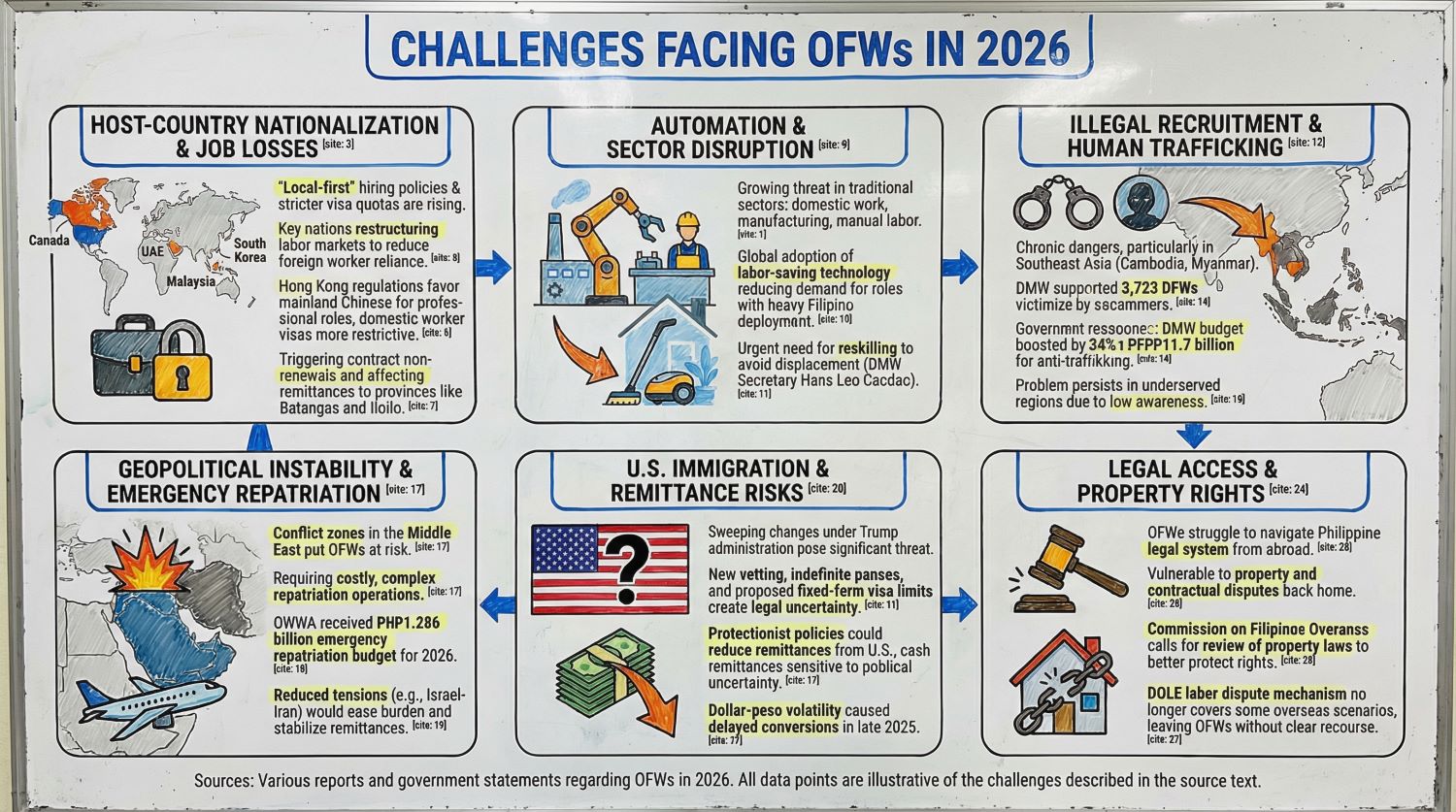
Nationalization policies prioritizing local hires in several key destination countries are emerging as one of the most immediate challenges. In the United Arab Emirates, Malaysia, South Korea, Canada and Hong Kong, governments are tightening visa rules, cutting foreign worker quotas and enforcing “local-first” hiring mandates. In Hong Kong, recent employment law amendments focus on local protections and talent admission schemes, including pilots for skilled trades and emphasis on mainland Chinese professionals under existing frameworks like the Admission Scheme for Mainland Talents and Professionals. These changes have led to non-renewals of contracts for many Filipino workers, particularly in professional and domestic roles, affecting remittance-dependent provinces such as Batangas and Iloilo.
Automation and sector-wide restructuring further erode demand for traditional OFW occupations in domestic work, manufacturing and manual labor. Department of Migrant Workers (DMW) Secretary Hans Leo Cacdac has stressed the urgent need for reskilling and continuous training to prevent displacement as host countries adopt labor-saving technologies.
Illegal recruitment and human trafficking continue to endanger vulnerable migrants, especially in Southeast Asia. The DMW provided aid to thousands victimized by scams in Cambodia and Myanmar, with recent repatriations including nearly 200 distressed workers rescued from trafficking hubs. To combat the issue, the government increased the DMW’s budget by 34% to 11.7 billion pesos ($203 million) for 2026, funding expanded anti-trafficking campaigns, crisis assistance and awareness efforts in underserved areas.
Geopolitical tensions in the Middle East remain a persistent concern, necessitating large-scale emergency repatriations. The Overseas Workers Welfare Administration (OWWA) secured a 1.286 billion peso allocation for such operations in 2026 — a notable rise — amid ongoing conflicts that threaten worker safety and remittance stability. Economists note that easing tensions, particularly between Israel and Iran, could significantly reduce risks.
In the United States, a major source of OFW remittances, immigration policies under the Trump administration are introducing uncertainty. Enhanced vetting, pauses on certain benefits and potential visa restrictions have prompted warnings from analysts about reduced flows from America. Some workers delayed currency conversions in late 2025 due to exchange rate volatility tied to political developments.
Back home, OFWs encounter barriers to legal recourse. Geographic distance complicates handling property disputes and contracts in the Philippines, prompting calls from the Commission on Filipinos Overseas for updated property laws to safeguard absentee owners. A recent Manila Times report highlights that the Department of Labor and Employment’s dispute resolution mechanism, including the Single Entry Approach, no longer fully applies to overseas workers following the creation of the separate DMW, leaving gaps in addressing grievances with foreign employers.
Despite these hurdles, the Philippine government has bolstered protections, including new DMW adjudication rules to speed up case resolutions and preventive measures against trafficking. Officials emphasize that while migration remains essential for many families, addressing root vulnerabilities through better preparation, skills upgrading and international advocacy is critical to safeguarding the millions of Filipinos working abroad.