





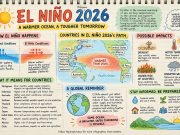

GENEVA — A rapidly strengthening El Niño is on track to drive central Pacific sea-surface temperatures to unprecedented levels, heightening the threat of severe heat, drought, and torrential flooding across the globe, the World Meteorological Organization said Thursday.
In its latest Global Seasonal Climate Update, the United Nations weather agency reported a near-100% chance that the climate pattern will persist through February 2027, with intensity expected to peak toward the end of the year.
“El Niño is firmly established and strengthening rapidly,” WMO Secretary-General Celeste Saulo said, cautioning that the event could rank as “one of the strongest since at least 1950.”
Forecasters project that between October and December, average sea-surface temperature anomalies in the key Nino 3.4 region of the central and eastern equatorial Pacific will surge to approximately 3.7 degrees Celsius (6.7 degrees Fahrenheit) above average. If realized, that mark would be the highest on record, substantially eclipsing the previous benchmark of 2.6 C (4.7 F) above normal registered from November 2015 to January 2016.
The agency warned that the system will likely trigger above-average temperatures across vast swaths of the planet while disrupting typical precipitation patterns worldwide. Wetter-than-normal conditions are anticipated across parts of North America, southeastern South America, the Greater Horn of Africa, sections of Central and East Asia, and the northern Arabian Peninsula. Conversely, drier conditions are projected to grip the Indian subcontinent, southern Central America, parts of the Caribbean, and northwestern South America.
Saulo emphasized that while El Niño does not generate new planetary heat, it discharges vast reserves of heat already stored in the sea into the atmosphere, compounding global climate pressures. The current system is drawing from an ocean that is “the warmest we’ve ever measured it,” she said.
The Geneva-based agency said national meteorological authorities and regional climate networks are coordinating closely with governments and humanitarian agencies to bolster disaster preparedness and mitigate potential fallout.