








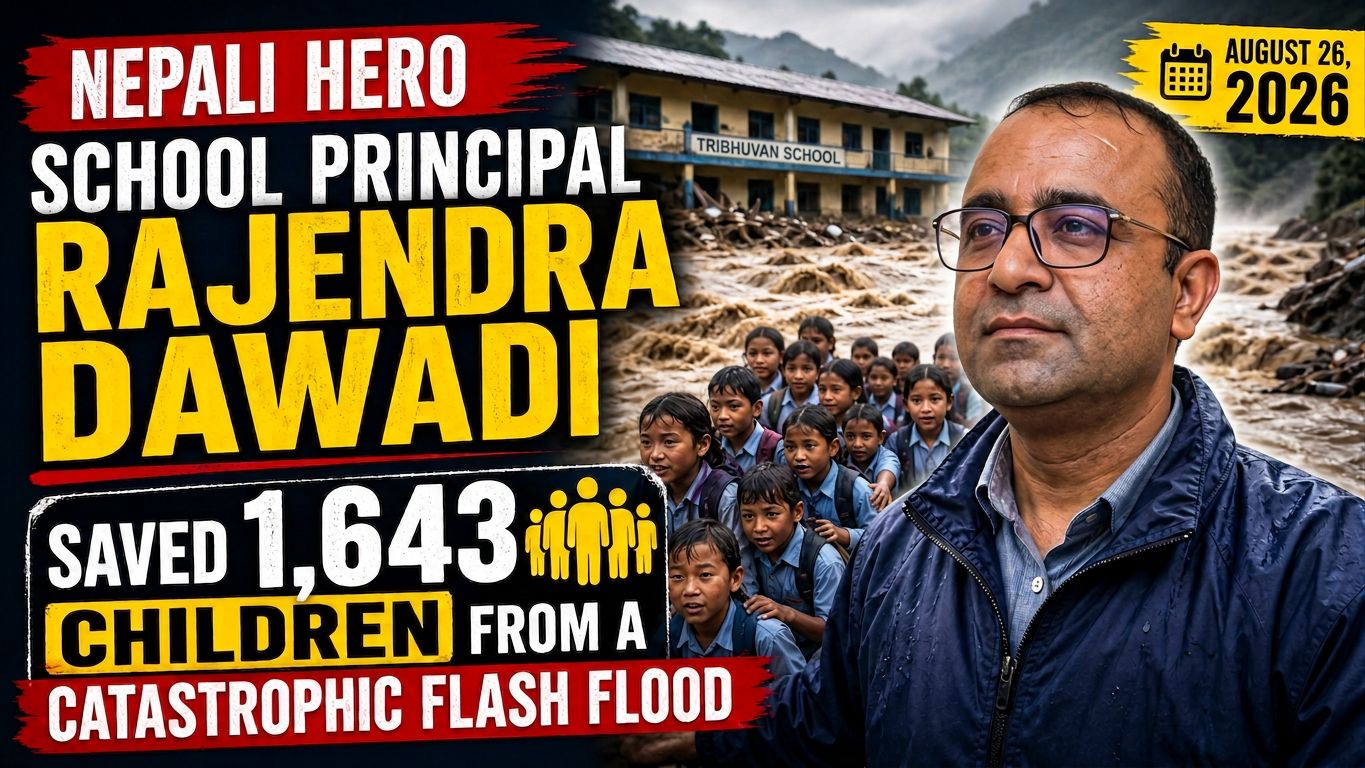
It began with a phone call.
On what should have been an ordinary school morning in Nepal’s Nuwakot district, Rajendra Dawadi received a terrifying warning from a friend upstream: a nearby village had been swallowed by the river.
“Run,” he was told.
For Dawadi, principal of Tribhuvan Trishuli Secondary School, there was no time to process the full scale of what was happening. There were children in classrooms, children arriving on foot, and school buses still heading toward campus. Within minutes, a catastrophic flash flood would tear through the area, washing away the school itself.
But because Dawadi acted immediately, all 1,643 students at the school reached safety.
Today, his actions are being recognised as an extraordinary act of leadership during one of the region’s most devastating natural disasters.
A Morning That Turned Into a Race for Life
The school stood in the Trishuli Valley, in an area that initially appeared to offer some protection. The three-storey concrete building was positioned well above the river, and at first, Dawadi believed it would be safe.
Then the situation changed.
A parent rushed to the school with urgent news: the water was rising rapidly. This was not a normal flood. A huge collapse of ice and rock high in the mountains had triggered a violent surge of water, mud, debris, and boulders through the river system.
The danger was moving fast.
Dawadi did not wait for a second warning.
He rang the school bell and instructed teachers to get every child out of the classrooms. Students were told to leave immediately and head uphill. At the same time, Dawadi began calling the drivers of school buses still on their way to campus.
He managed to reach nearly all of them and told them to turn back.
One bus driver could not be contacted in time. When Dawadi later saw that bus approaching the bridge near the school, he urgently told the driver to reverse. The bus reportedly made it back across just before the bridge collapsed.
“The Rest I Sent Uphill”
As floodwater began entering the school grounds, fear spread among the students. Children who had arrived expecting a normal day of lessons suddenly found themselves fleeing for their lives.
One girl suffered a panic attack and was taken uphill on a motorbike. The rest of the students ran on foot, moving as quickly as they could toward higher ground.
Dawadi followed behind them.
The children eventually gathered beneath a bodhi tree above the danger zone. From there, they watched as the flood surged through the area below, destroying buildings, infrastructure, and the school they had only just escaped.
The school was gone, but its students were alive.
Not a Hero’s Plan—Just a Principal Doing His Duty
The scale of the evacuation is difficult to comprehend. Moving 1,643 children away from a school campus in a matter of minutes would be challenging under any circumstances. Doing so as floodwaters close in, panic grows, bridges collapse, and communications fail is something else entirely.
Yet Dawadi has reportedly spoken about his actions with striking humility.
When praised as a hero, he asked, “What else could I do?”
That simple response captures why his story has resonated with people around the world. He did not set out to be heroic. He saw children in danger and understood that waiting could cost lives.
He made decisions quickly. He trusted teachers to help. He communicated with bus drivers. He moved students to higher ground. And he stayed with them until they were safe.
A Lesson in Preparedness and Leadership
The tragedy in Nuwakot is a painful reminder of how quickly disasters can unfold in mountainous regions. Flash floods, landslides, and glacial events can transform familiar landscapes into deadly environments within minutes.
For schools, the lesson is especially urgent. Emergency planning is not just paperwork. Clear evacuation routes, reliable communication, trained staff, and leaders who can remain calm under pressure can save lives.
Rajendra Dawadi’s response showed the power of those principles in the most difficult circumstances imaginable.
The School Was Lost, but the Children Survived
The flooding caused immense destruction across the region and brought devastating loss to many families and communities. The survival of 1,643 students does not erase that grief.
But amid the destruction, Dawadi’s actions remain a powerful story of hope.
A school principal heard a warning. He believed it. He acted without delay.
And because he did, 1,643 children were given the chance to return home.
Reported sources: India Today, Outlook India, and Mathrubhumi English.