







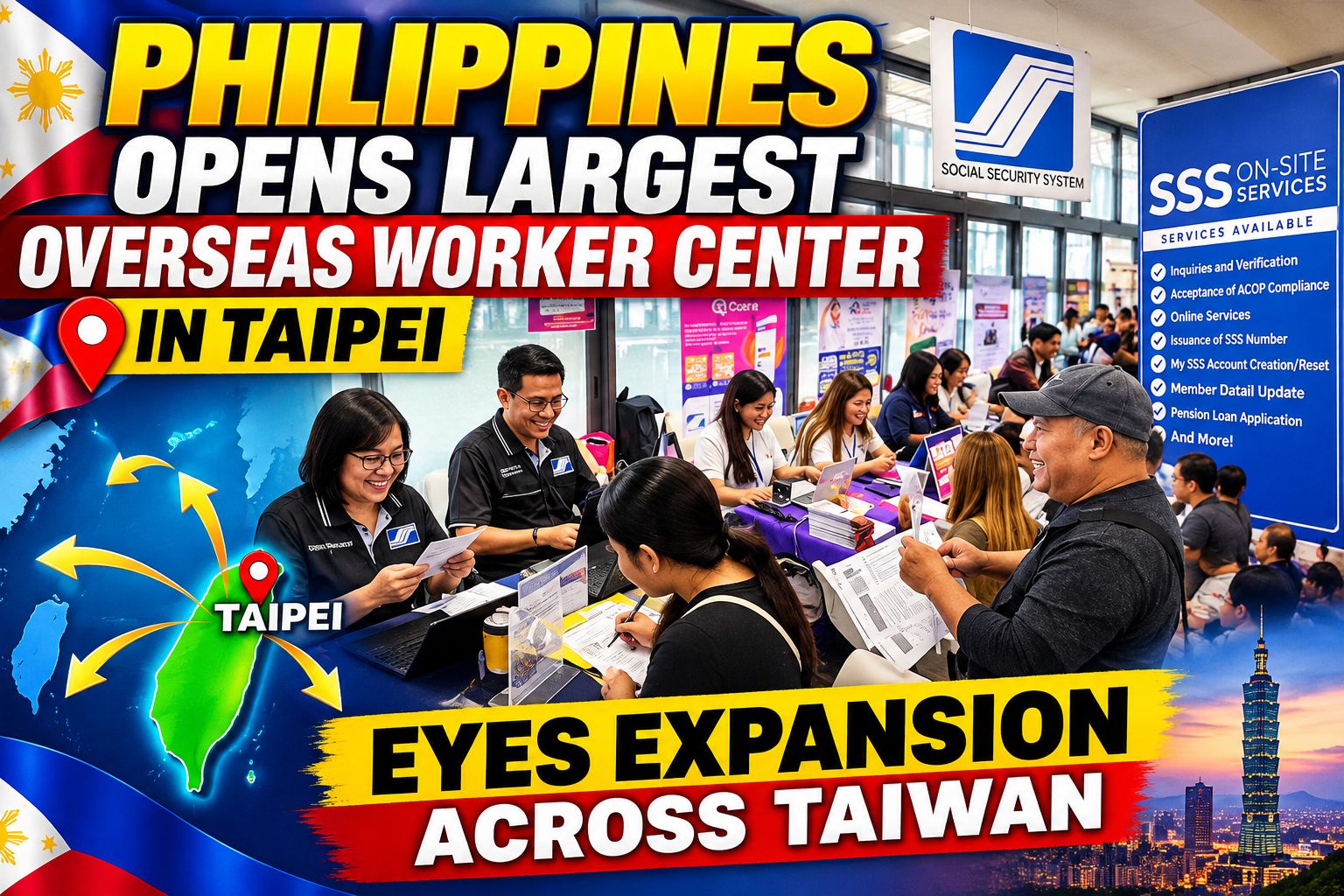
TAIPEI, Taiwan — The Philippines opened its largest service center for overseas Filipino workers in Taipei on Oct. 11, offering government assistance, job training and counseling as officials consider two more locations in Taiwan.
The OFW Global Center-Taipei is the third such facility worldwide, following centers in Hong Kong and Kuala Lumpur, said Patricia Yvonne Caunan, administrator of the Philippines’ Overseas Workers Welfare Administration.
Located in Taipei’s Neihu District, the center shares a building with the Manila Economic and Cultural Office, the Philippines’ de facto embassy in Taiwan. It is designed to help Filipino migrant workers access government services and welfare assistance without returning to the Philippines.
About 191,000 Filipino migrant workers were living in Taiwan at the end of August, according to Taiwan’s Ministry of Labor. More than 61,000 were in Taipei, New Taipei City and Taoyuan.
The new facility includes training spaces, government service areas, a cafe serving free coffee and a karaoke room. Planned courses cover Mandarin, financial literacy, computers, artificial intelligence, content creation and entrepreneurship.
“Skills are the best protection for migrant workers. You can never take away skills,” Caunan said.
She said the training could help workers pursue different careers or start businesses after returning home. Counseling and opportunities to socialize would also help address the emotional challenges of living far from family, she said.
“Just walk in and make sure that you make yourself comfortable in our cafe,” Caunan said when asked how workers could access the services.
The administration hopes to establish similar centers in Taichung and Kaohsiung within two years, with feasibility studies underway. The proposed facilities would likely be near the Manila office’s branches, Caunan said.
“We don’t want our OFWs in Kaohsiung to travel all the way to Taipei just to experience this,” she said.
Corazon Avecilla-Padiernos, chairperson of the Manila Economic and Cultural Office, said the Taipei center reflected the Philippine government’s commitment to supporting citizens abroad.
“Wherever our Filipinos may be, the care and support of our government must remain within their reach,” she said at the opening ceremony.
Workers welcomed the prospect of easier access to services and training.
Geraldine G. Domingo, 54, a Taipei-based caregiver who has worked in Taiwan for 12 years, said she was particularly interested in Mandarin classes to improve communication with Taiwanese employers and friends.
“This is very convenient now because everything is here already, what a Filipino overseas worker needs,” she said.
Judith Vidal Mendoza, 37, a caregiver who has worked in Taiwan for eight years, said workers often need time off to handle administrative procedures. She hoped the center would offer faster document processing and additional services.