






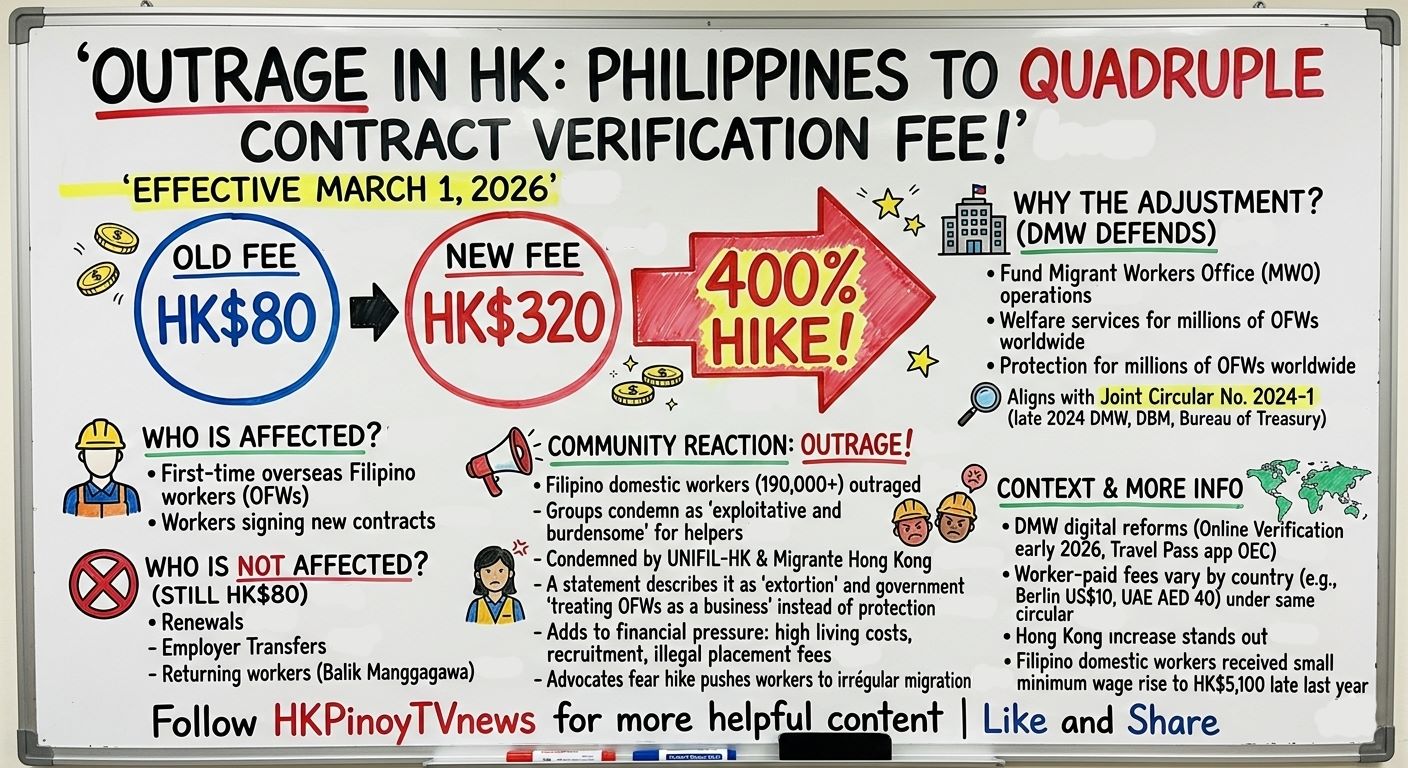
The Philippine government is set to quadruple a key fee for verifying new employment contracts of overseas Filipino workers in Hong Kong, prompting sharp criticism from migrant advocacy groups who call the increase exploitative and burdensome for low-wage domestic helpers.
Under a policy adjustment effective March 1, 2026, the Migrant Workers Office (MWO) in Hong Kong will raise the verification fee for new land-based and sea-based contracts from HK$80 (about PHP 600 or US$77) to HK$320 (about PHP 2,400 or US$41), a 400% hike. The change, announced in a public advisory by the Philippine Consulate General and MWO, aligns with Joint Circular No. 2024-1, issued in late 2024 by the Department of Migrant Workers (DMW), Department of Budget and Management and Bureau of the Treasury.
The fee applies to first-time overseas Filipino workers (OFWs) and those signing new contracts, while renewals, employer transfers and returning workers (known as Balik Manggagawa) remain at HK$80. Contract verification is a mandatory step to confirm compliance with Hong Kong labor and immigration laws, often required for issuing an Overseas Employment Certificate (OEC) or its digital versions needed for deployment.
The DMW has defended the adjustment, stating that verification fees help fund MWO operations, welfare services and protections for millions of OFWs worldwide. The agency has also rolled out digital reforms, including an Online Employment Contract Verification System launched earlier in 2026 and integration of the OEC into the OFW Travel Pass app, to streamline processes and reduce paperwork for returning workers.
Filipino domestic workers in Hong Kong — who number over 190,000 and form a major part of the city’s migrant workforce — have reacted with outrage. Community groups say the fee adds to existing financial pressures, including high living costs, recruitment expenses and, in some cases, illegal placement fees charged by agencies.
United Filipinos in Hong Kong (UNIFIL-HK), a militant advocacy organization representing domestic workers, condemned the increase in a strongly worded statement.
“From HK$80 to HK$320! Migrante Hong Kong condemns the unreasonable increase in verification fees for all new contracts,” the group said, using the Filipino term for the policy. “The service is already failing, and this is another burden on OFWs. It is clearly another form of extortion. The Marcos Jr. government has no qualms treating OFWs as a business instead of providing proper protection and improving services.”
The statement continued: “Despite the increase in the DMW budget, they still managed to raise the verification fee fourfold for all new contracts. It’s like pouring salt on the wound, especially when those involved in serious corruption in the country have yet to be held accountable.”
UNIFIL-HK vowed continued protests “until this and other mandatory government fees are scrapped.” Chairperson Dolores Balladares-Pelaez provided contact details for the group, which is based at St. John’s Cathedral in Central.
Protests have already occurred in the lead-up to the March 1 implementation, with advocates arguing the hike could discourage formal processing and push some workers toward irregular migration channels.
Fee structures vary by country under the same joint circular. In places like Berlin, worker-paid fees for certain first-time contracts remain around US$10, while in the UAE they stay at about AED 40 (with added convenience fees for online systems). Hong Kong’s sharp increase stands out amid recent positive developments for Filipino domestic workers there, including a small minimum allowable wage rise to HK$5,100 (about US$655) per month approved late last year.
As the deadline nears, worker advocates are pressing for a policy review or subsidies for vulnerable groups. The DMW maintains the changes support sustainable service delivery for Filipinos abroad.
OFWs in Hong Kong are advised to consult official MWO advisories for the latest details and prepare for the new rates.