






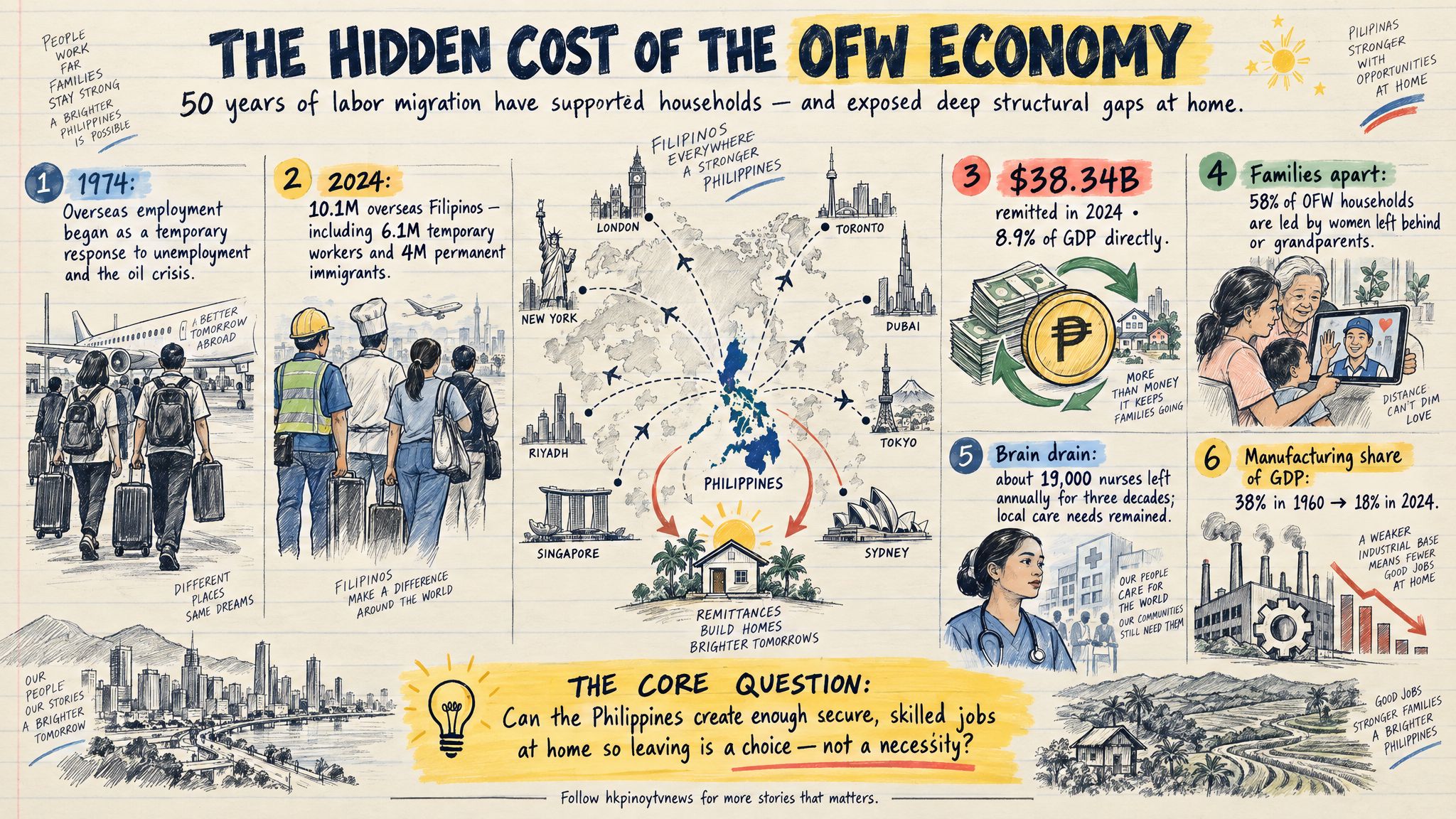
MANILA, Philippines — For half a century, the Philippines has leaned on its citizens abroad to keep the national economy afloat, sending millions of laborers across the globe to wire home tens of billions of dollars each year.
Yet behind the record $38.34 billion remitted in 2024 lies an escalating social and structural toll: fractured households, a depleted professional workforce, and a half-century economic strategy that critics argue has stunted domestic manufacturing while turning emigration into an institutionalized survival mechanism.
What began in 1974 under President Ferdinand Marcos Sr. as an emergency measure to counter soaring domestic unemployment and absorb Middle East petrodollars has morphed into an entrenched policy. In a detailed economic study authored by researcher Dr. Teodoro C. Mendoza, the five-decade trajectory of the Overseas Filipino Worker (OFW) model is cast not as an unalloyed success story, but as the reflection of long-term economic shortfalls.
Official statistics compiled by the Philippine Statistics Authority place the global diaspora at more than 10 million people, comprising 6.1 million temporary contract workers and roughly 4 million permanent emigrants, along with an estimated 1.8 million irregular migrants.
Directly and indirectly, their earnings account for roughly one-fifth of the nation’s economic output, serving as an indispensable buffer that prevented acute foreign exchange and sovereign debt shocks. But that safety net has carried hidden, compounding consequences across Philippine society.
Researchers point first to the domestic vacuum left behind. About 58% of OFW households are run either by solo mothers or by grandparents. Studies by UNICEF and the Philippine Institute for Development Studies cited in the report found children raised in these split households face a 40% higher rate of anxiety, lower academic performance, and higher rates of teenage pregnancy, with long-distance video calls offering an inadequate substitute for parental care. Local court filings in provinces such as Cebu and Pampanga now list overseas deployment as the second leading catalyst for marital annulments, trailing only infidelity.
The toll is particularly severe among the roughly 180,000 domestic workers and caregivers dispatched annually to hubs including Hong Kong, Singapore, and the Persian Gulf. Their departure frequently forces rural families to rely on secondary caregivers from even poorer communities, contributing to an estimated 1.2 million unattended elderly citizens across rural provinces.
Physical safety remains another chronic concern. Government logs record roughly 24,000 overseas workers encountering severe distress, legal detention, or employer abuse each year, with 400 to 500 returning home in caskets annually. From historical executions and freezing deaths to the recent repatriation of Mary Jane Veloso following a 16-year legal ordeal abroad, low-wage migrants regularly confront perilous conditions in host countries featuring weak statutory labor safeguards.
Beyond immediate family disruption, economists warn of an enduring drain of professional human capital. Training a single nurse at public institutions costs approximately 1.2 million pesos ($21,000), yet the country has sent an estimated 19,000 nurses overseas annually for decades. That steady exodus left local facilities with a nurse-to-patient ratio of roughly 1:45—far wider than the World Health Organization’s recommended 1:12 benchmark—and caused acute staffing shortages during the height of the COVID-19 pandemic. Similar outflows have hollowed out technical disciplines, including engineering, software architecture, and specialized education, often pushing credentialed teachers and agronomists into low-skill domestic or service roles overseas.
This continuous brain drain, the report argues, has reinforced an import-heavy, consumption-driven domestic economy. Heavy foreign currency inflows buoy the Philippine peso, making foreign imports cheaper while squeezing local manufacturers and farmers. Consequently, manufacturing’s contribution to gross domestic product declined from 38% in 1960 to roughly 18% in 2024.
At the same time, the steady supply of overseas earnings acts as a political release valve, dampening pressure on policymakers to enact tough land reforms, raise basic wages, or invest in automated domestic industry.
With the nation’s population surpassing 115 million and expanding by roughly 1.5 million working-age entrants each year against only 500,000 newly generated formal jobs, labor export remains the default route out of poverty.
Mendoza’s analysis warns that without decisive policy shifts—such as channeling 10% of remittances into productive agricultural cooperatives, granting tax holidays to returning technical entrepreneurs, and aggressively enforcing reproductive healthcare initiatives—the country could see its overseas population double to 20 million by midcentury, perpetually celebrating its migrant laborers as national heroes while failing to build viable futures for them at home.