







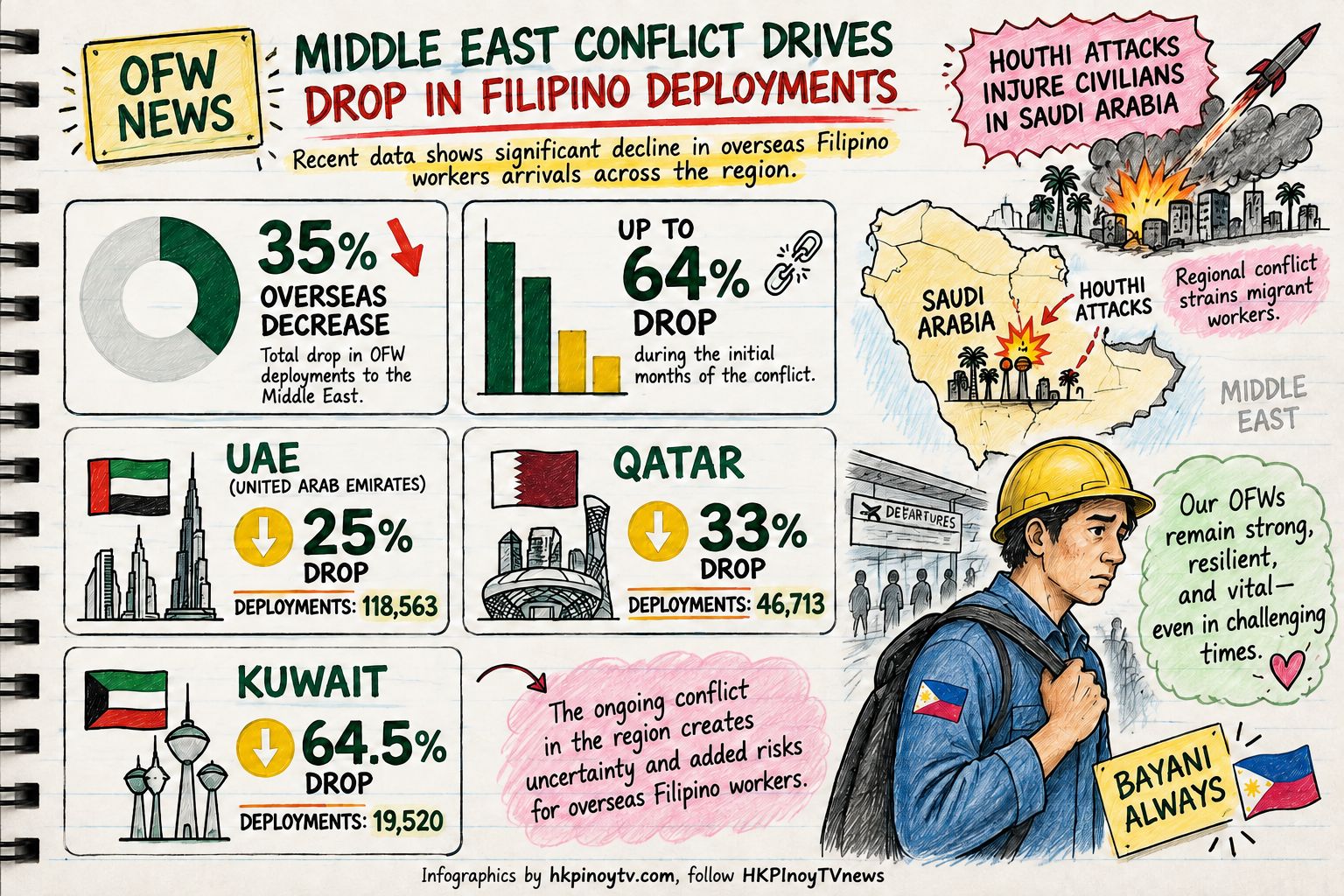
Thirteen civilians were injured in missile and drone attacks on three Saudi cities, the Saudi-led coalition said Tuesday, as broader instability in the Middle East heightened concerns for millions of migrant workers across the Gulf.
Coalition spokesman Turki al-Malki said the Houthi attacks struck Khamis Mushait, Abha and Taif on Monday. The injured civilians suffered minor to moderate wounds, he said, while seven homes and two vehicles were damaged.
Al-Malki accused Yemen’s Houthi rebels of deliberately targeting civilians and civilian infrastructure, saying the coalition would respond under what it described as its right to self-defense.
The Houthis said the attacks followed Saudi airstrikes in Yemen. Houthi military spokesman Yahya Saree said Saudi F-15 and Typhoon warplanes carried out 54 strikes across five Yemeni provinces during the previous 24 hours, and warned that the strikes would draw a response.
The group also claimed responsibility for a large-scale missile and drone operation targeting King Khalid Air Base in Khamis Mushait.
The exchange underscored the risks facing Gulf countries that rely heavily on foreign workers. In a separate report on regional conflict, Philippine officials said security concerns, airspace closures and flight disruptions have curtailed the movement of overseas Filipino workers, or OFWs, to the Middle East.
The Philippine Department of Migrant Workers said deployments to the region fell 35% from a year earlier during the period cited in the report, with larger declines recorded during the conflict’s early months. Government figures showed deployments fell in Saudi Arabia, the United Arab Emirates, Qatar and Kuwait.
An estimated 2.4 million Filipinos live and work across the Middle East, many in Saudi Arabia and the UAE, where they are employed in domestic work, health care, hospitality, retail and other service industries.
Philippine officials said they had not raised crisis alert levels for Gulf states, citing protections provided by host governments, but urged recruitment agencies and employers to maintain contact with workers and prepare evacuation plans. Agencies were also advised at one point to temporarily halt processing for workers headed to several Gulf countries because of airspace restrictions.
For workers and their families, the disruptions have raised questions about both safety and income. Remittances from Filipino workers abroad are a major source of foreign currency for the Philippines, and uncertainty over employment in the Middle East has added pressure on households that depend on money sent home.
Yemen has been at war since the Houthis seized the capital, Sanaa, and other areas in 2014. A Saudi-led coalition intervened the following year in support of Yemen’s internationally recognized government. After years of relative calm, fighting between government forces and the Houthis escalated again in early July.