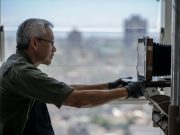


In an era when most photographs live and die on a screen—made, shared, forgotten in the span of a scroll—Bangkok-based Filipino photographer Nico Sepe is offering something stubbornly physical: portraits created the way the medium once insisted they be made, with chemistry, patience, and a certain amount of risk.
From March 16–21, 2026, Sepe will be in Ban Vatchan, Vientiane, for a short run of wet-plate collodion portrait sessions. Then, on March 21 (full day), he’ll lead a Complete Wet Plate Collodion Workshop—a limited-seat immersion billed as “Master the Plate with Nico Sepe.” Booking is required via 20 91 484 369 or Facebook (as listed on the workshop poster).

It’s a brief visit. But the process he’s teaching belongs to a different relationship with time altogether.
A 19th-century process in a 21st-century city
Wet-plate collodion is often described as “Victorian photography,” but that label can flatten its real character. The technique—developed in the 1850s—requires the photographer to coat a plate (metal or glass), sensitize it, expose it, and develop it while it is still wet, working against the clock. The reward is an image with a distinctive depth: silvery tonalities, crisp detail, and a tactile presence that feels less like “content” and more like an object.
The Vientiane sessions emphasize that materiality. In the workshop brief, the portraits are described as being captured on a physical plate of metal or glass, and as durable, archival objects designed to last for generations—an intentionally old-fashioned promise that lands differently in Laos, where family photographs often serve as heirlooms as much as keepsakes.

Sepe’s long arc: from documentary urgency to slow craft
Sepe’s biography reads like a map of Southeast Asia’s political and cultural shifts. His full-time commitment to photography began in the late 1970s, and he spent the 1980s documenting lives within the underground movement during the final years of the Marcos dictatorship in the Philippines. Over decades he contributed significantly to documenting social and political change, working with NGOs as well as self-funded projects, and he co-founded CENTERPHOTO (now the Philippine Center for Photojournalists)—a formative institution in Filipino documentary photography.
What’s striking is how wet plate, for Sepe, isn’t a nostalgic detour. He has framed it as a return to photography as a process—a discipline of making that resists the frictionless ease of the digital image. In a 2018 feature on his workshops, Sepe put it plainly: “Photography is a process—a chemical process. It is not just like pushing the button,” adding that his purpose was to keep refining wet plate and apply it to documentary work.
Reputation in Bangkok: exhibitions and a wider public presence
Sepe’s Bangkok profile extends beyond the darkroom. In 2022, he launched “Co-Labs” at the Bangkok Art and Culture Centre (BACC)—a project created with Thai artists with special needs, using wet-plate collodion as both medium and message. Speaking at the opening, he described the process’s historical resonance and positioned the work as advocacy, aiming to raise recognition and awareness for people with special needs; he dedicated the project to his nephew with Down syndrome. It’s the kind of exhibition that helps explain why his workshops draw serious interest: the craft isn’t performed as retro theater—it’s deployed with contemporary stakes.
What participants can expect in Vientiane
The Vientiane offering has two distinct entry points:
- Portrait sessions (March 16–21): a rare chance for individuals or families to commission a one-of-a-kind wet-plate portrait in Ban Vatchan—a setting that, with its craft traditions and historic atmosphere, feels like an apt stage for a process that demands presence from everyone involved.
- Full-day workshop (March 21): an intensive, hands-on introduction to the “complete” workflow—learning to master the plate, as the poster promises.
Nico has conducted workshops and exhibits on the wet-plate collodion process in Thailand, Vietnam, Paris, Plymouth (UK), and the Philippines in addition to the planned session in Laos.

Even without a published syllabus, wet plate workshops typically revolve around the core chain of actions—coating, sensitizing, exposing, developing, fixing—plus the practical realities: managing a portable darkroom rhythm, handling chemicals safely, and learning how small choices (light, timing, plate preparation) become the difference between a ghostly failure and a portrait that seems to glow from within.
And that’s the real seduction of Sepe’s workshop: not simply learning an antique technique, but learning to think like photography’s earliest practitioners—when every frame carried consequence, and every portrait required collaboration between sitter, light, and chance.
About the author: Rodolfo Canete Jr. is a Hong Kong-based journalist, curator and multi-disciplinary artist.