



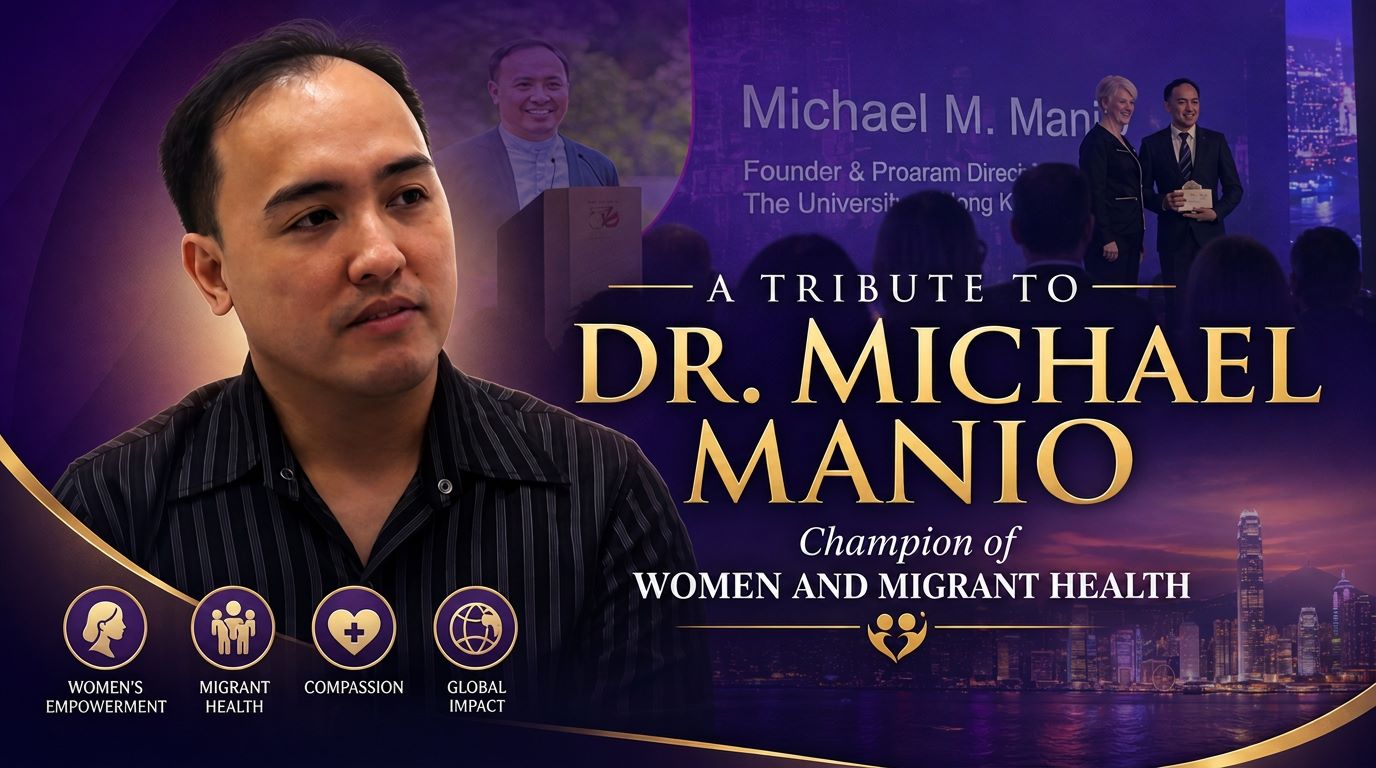
Dr. Michael “Mike” Manio was a physician, scientist, educator, and community builder whose life’s work stitched together biochemistry, public health, and the everyday struggles of migrant workers in Hong Kong. His sudden passing on July 13, 2026 — news shared by the School of Biomedical Sciences at the University of Hong Kong — has left students, colleagues, and communities grieving a teacher who made science deeply human.
Life and vocation
Born and trained in the Philippines, Michael Manio first completed a BS in Biology at Angeles University Foundation, followed by a Doctor of Medicine at the same institution, laying the clinical foundation that would anchor his later work in research and public health. He went on to earn a Master in Health Professions Education from the University of Santo Tomas with honors, then two PhDs: one in Biochemistry (initially at UP Manila, later transferred) and another in Vascular Pharmacology completed at HKU in 2014.
Across more than 15 years in academia, he served as Assistant Professor in Medicine and Nursing at universities in the Philippines and later as a lecturer in Hong Kong, including at Hong Kong Metropolitan University. Those who knew him on campus often simply called him “Lecturer Mike” — a title that captured the warmth and accessibility with which he approached teaching.
Scholar and teacher
Scientifically, Dr. Manio’s work spanned cardiovascular disorders, endothelial biology, and vascular pharmacology, exploring how thyroid hormone and other factors affect blood vessels and immune responses. His co?authored publications covered topics from mesenchymal stem cell–mediated immunosuppression in graft-versus-host disease models to the vascular effects of thyroid hormone in rat arteries, contributing to the broader understanding of complex cardiometabolic disease.
Yet his research interests were never confined to the lab bench. He cared deeply about teaching and learning in biochemistry and human pathophysiology, curriculum development, health education, and health promotion, treating pedagogy itself as a field worthy of rigorous thought and continuous improvement. Students and colleagues recall not just the detail of his lectures but his insistence that scientific knowledge must ultimately serve people in tangible, ethical ways.
Voice for health and migrant communities
Beyond formal academia, Dr. Manio became a trusted voice for health in Hong Kong’s Filipino community and among overseas domestic workers more broadly. He hosted and guested on radio programs with RTHK and DBC and appeared on TVB Pearl, translating complex medical concepts into practical guidance in Tagalog and English for audiences who often had limited access to formal healthcare.
For years, he wrote a monthly health column dedicated to issues facing overseas Filipino workers in Hong Kong, tackling topics from chronic disease to reproductive health in language and stories that resonated with domestic workers’ lived realities. In doing so, he turned media platforms into a form of community clinic — a place where people could learn, ask questions, and feel seen.
EmpowerU and community leadership
One of his most significant legacies is the service learning platform he created to empower domestic workers and their families through health and wellness, law and gender equality, environmental sustainability, culture, and the arts. This program connected university students with migrant workers in an unusually deep way, reaching some 20,000 community members and engaging about 150 students from 27 countries — a scale that is rare for such grassroots, education-focused initiatives.
Through EmpowerU and related work, he built what newspapers described as a “powerhouse team” of academic staff, students, volunteers, and domestic workers themselves, all dedicated to uplifting workers’ lives in Hong Kong. His leadership within ethnic minority mental health advocacy and empowerment efforts made him a lay leader not only in health but in social justice, helping to bridge the gap between institutions and marginalized communities.
Honors without complacency
Recognition followed, but it never seemed to blunt his sense of responsibility. He received the “Champion of the Advancement of Women” award at the American Chamber of Commerce in Hong Kong’s Women of Influence Awards in 2019, acknowledging his work in empowering women domestic workers. He was also named “Global Filipino in Health Education” by the Philippine Association in Hong Kong, and earlier in his career he earned research honors such as a Young Investigator/Scientist Award and a Most Outstanding Poster Presentation at HKU scientific meetings.
These accolades marked him as a bridge figure: someone who could excel in high-level biomedical research while staying grounded in the realities of frontline health education and migrant advocacy. For many observers, he embodied what it means to use academic privilege in service of those who rarely enter lecture halls or research centers.
Mentor, colleague, and friend
Within HKU and HKMU, Dr. Manio was known as a resident tutor, mentor, and guide, supporting students not only in their studies but in leadership development and personal growth. He mentored students through HKU’s leadership development goals and Common Purpose programmes, helping young people think about health, ethics, and social responsibility together rather than as separate silos.
Colleagues recall his generosity with time and ideas — the way he would stay after classes to answer questions, help refine research proposals, or simply listen to the pressures students were under. For many first-generation and ethnic minority students, his presence as a Filipino scholar and educator in Hong Kong was itself a powerful signal that they, too, belonged in the world of science and higher education.
Legacy
Dr. Michael Manio’s life traced an arc from provincial classrooms in Guagua and Angeles to research labs and lecture theatres in Hong Kong, but he never forgot that the truest measure of scholarship is its impact on ordinary lives. He used every platform available — lectures, radio, television, newspaper columns, service-learning projects — to make health knowledge accessible, dignifying, and actionable for those who often live at society’s economic and social margins.
In mourning his passing, people across universities, consulates, migrant organizations, and churches are also celebrating a life that refused to choose between excellence and empathy. For his students, colleagues, and the thousands of workers and families who learned from him, Dr. Manio leaves behind not just a body of scientific work, but a lived example of what it means to be a doctor and educator who truly takes the community to heart