







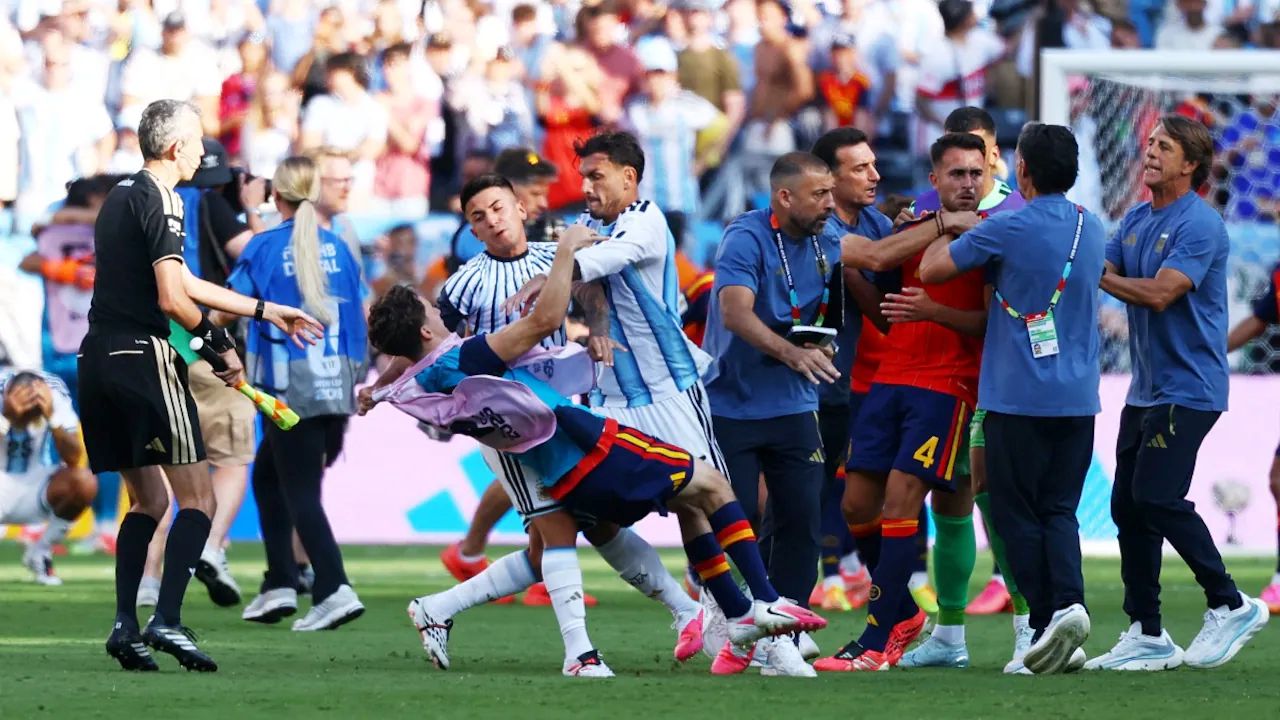
The 2026 World Cup final was expected to be a showcase of attacking brilliance between two footballing giants. Instead, Argentina’s performance against Spain will be remembered less for its ambition and more for its alarming lack of it. In a match that ended in defeat and widespread criticism, Argentina appeared to abandon any meaningful attempt to score, opting instead for a disruptive and increasingly unsportsmanlike approach.
From the opening whistle, Spain imposed their identity: patient possession, structured movement, and relentless attacking pressure. Argentina, by contrast, retreated into a combative shell. What stood out most was not just their defensive posture, but the apparent absence of offensive intent. Across the full 90 minutes, Argentina recorded zero shots on target—a statistic almost unthinkable at this level, particularly in a World Cup final.
Spain, meanwhile, delivered a masterclass in controlled aggression. They registered 20 shots on target, consistently stretching Argentina’s defense and forcing repeated interventions from their goalkeeper. The numerical disparity tells a stark story: one team playing to win, the other seemingly focused on disruption.
Argentina’s tactical shift became more controversial as the match wore on. Rather than pressing intelligently or building transitions, they increasingly relied on physical fouls to break Spain’s rhythm. Late challenges, tactical fouling, and repeated infringements disrupted the flow but also drew mounting scrutiny from officials and spectators alike. It was a strategy that hinted at frustration rather than calculation.
While physicality has always been part of Argentina’s footballing identity, this iteration crossed a line. The accumulation of fouls did little to slow Spain’s momentum and instead contributed to a loss of discipline. The referee’s notebook filled quickly, and Argentina’s inability to regain composure only deepened their predicament.
In contrast, Spain’s composure under pressure highlighted the gulf in approach. They absorbed the fouling without losing structure, continuing to create chances and maintain territorial dominance. Their 20 shots on target were not merely a statistical advantage but a reflection of sustained attacking intent and tactical clarity.
For Argentina, the defeat raises serious questions about decision-making at the highest level. Finals are often tight, tactical affairs, but rarely does a team of Argentina’s pedigree finish without a single credible scoring attempt. The choice to prioritize disruption over creation ultimately backfired, leaving them not only defeated but also criticized for their approach to the game.
In the end, the final was not just decided by goals, but by philosophy. Spain played football. Argentina, for long stretches, did not.