








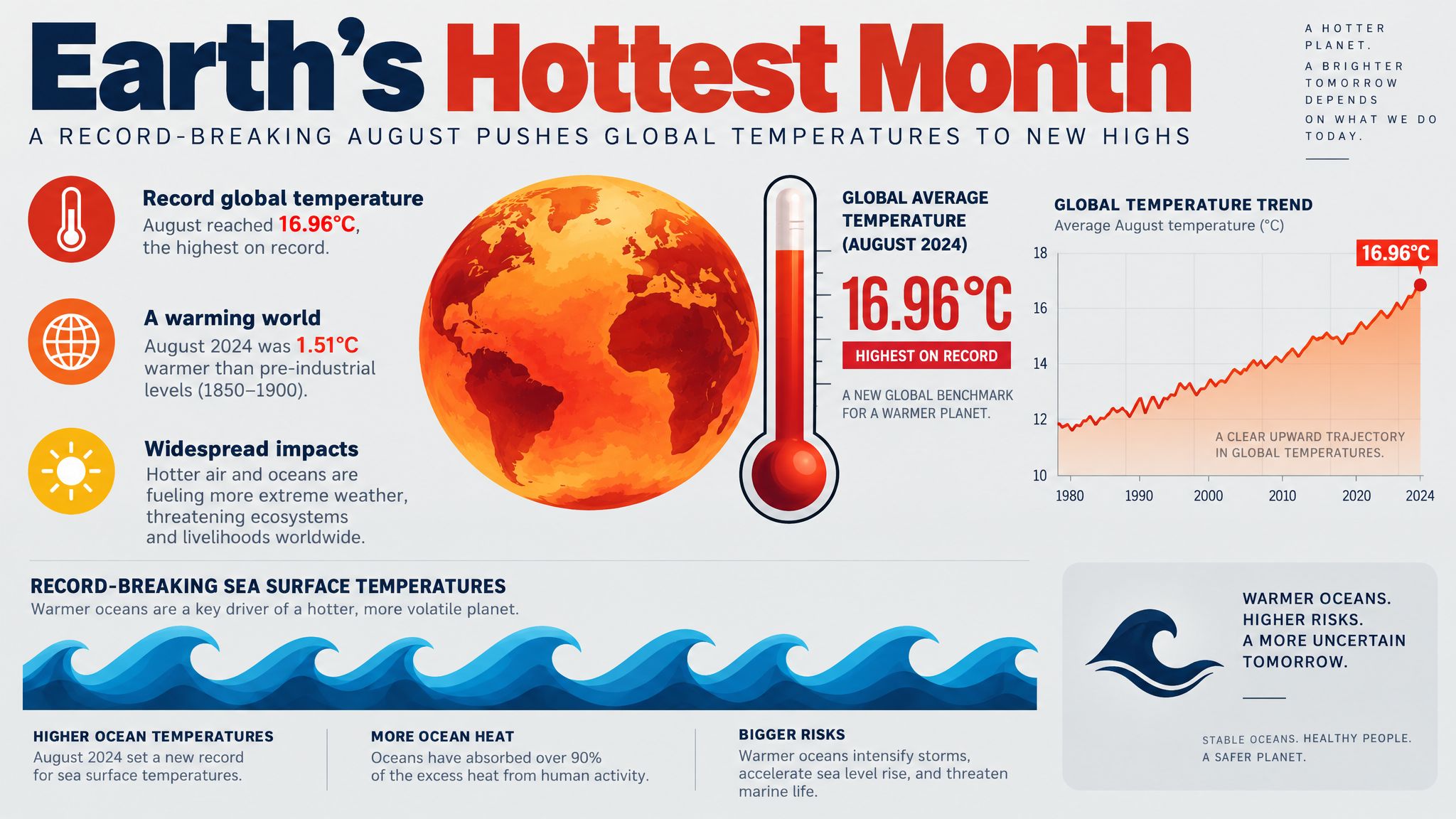
GENEVA — August was the hottest month ever recorded globally, European Union scientists announced Thursday, as unprecedented ocean warmth and blistering heat waves capped western Europe’s warmest summer on record.
Global average air temperatures reached 16.96 degrees Celsius (62.53 degrees Fahrenheit) during the month, according to the Copernicus Climate Change Service. That edges past the previous all-time mark set in July 2023 by 0.01 degree Celsius, leading the agency to consider both months effectively tied for the title of Earth’s warmest.
The findings drew an urgent warning from the United Nations, which cautioned that the planet will drift further into uncharted territory unless nations rapidly transition away from fossil fuels.
“The evidence is irrefutable: this is the spiralling price of humanity’s fossil fuel addiction, and the global climate crisis it is fuelling,” said Simon Stiell, the U.N. climate chief.
While Copernicus records date to 1940, researchers rely on natural archives such as ice cores, tree rings, and coral skeletons to measure current conditions against long-term climate patterns. Samantha Burgess of the European Centre for Medium-Range Weather Forecasts, which oversees the service, noted that humans have arguably not experienced temperatures this high in at least 100,000 years.
Scientists attribute the spike to human activity, predominantly the burning of coal, oil, and gas, which has driven average planetary temperatures roughly 1.4 degrees Celsius above pre-industrial levels and amplified the intensity of extreme weather. Despite international reduction targets, emissions of heat-trapping greenhouse gases climbed to new peaks in 2025.
The surge in heat was equally pronounced at sea. Global sea surface temperatures reached a record daily high and matched the hottest August levels ever measured, extending an unprecedented streak of ocean warmth into its third month.
Oceans have absorbed more than 90 percent of the excess heat trapped by greenhouse gases, shielding land masses from harsher extremes while exacting a heavy toll on coral reefs, marine ecosystems, and coastal regions. Heat records fell across basins including the Atlantic and the Mediterranean, as well as the tropical Pacific, where scientists are tracking one of the strongest El Niño patterns of the modern era.
The phenomenon, characterized by abnormally warm Pacific waters, typically disrupts global weather systems thousands of miles away, heightening the risk of flooding in South America, droughts across Africa, and severe bushfires in Australia.