









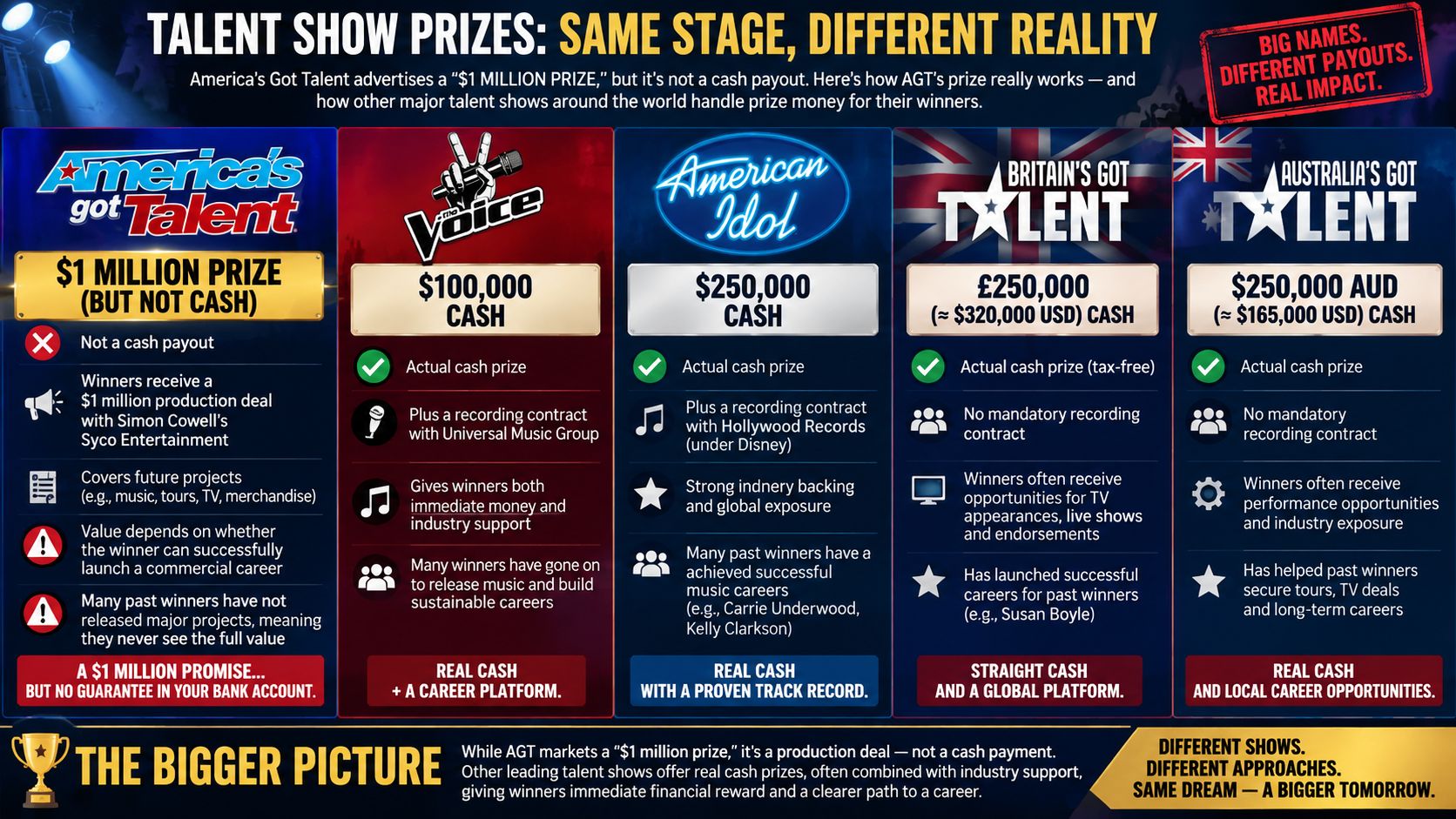
An investigative examination of the reality competition’s headline prize, its 40-year payment structure, and how it compares with rival talent shows.
The prize that sounds bigger than it is
When America’s Got Talent crowns a winner, the announcement is designed to sound transformative: the champion has won the show’s much-vaunted $1 million prize.
But the winner does not ordinarily receive a $1 million check. The program’s disclosed terms say the prize is payable as a financial annuity over 40 years, or that the contestant may choose the present cash value of that annuity. In practical terms, the standard structure has been described as approximately $25,000 a year for 40 years, before taxes. The alternative is a discounted lump sum whose value depends on financial calculations and prevailing interest rates.
That distinction is not a technical footnote. It determines how much money the winner can access, when it can be accessed, and how much inflation will erode the later payments.
The table below compares America’s Got Talent with four major talent competitions. Amounts and conditions can change by season, so the comparison reflects publicly reported recent structures rather than assuming that every historical season was identical.
| Show | Headline prize | Payment structure | Additional benefit | Main financial caveat |
| America’s Got Talent | $1 million | Approximately $25,000 annually for 40 years, or a present-value lump sum | Las Vegas headline opportunity | The advertised total is not normally available as immediate cash; taxes apply |
| The Voice | About $100,000 | Generally described as a cash award | Recording contract, reportedly with Universal Music Group | Contract terms, royalties, advances, and recoupment can affect the real value |
| American Idol | About $250,000 | Recent reporting describes staged payments, including $125,000 upfront and another $100,000 after delivery of the debut album | Recording contract, recording budget, management and living support | Much of the money functions as a recording advance and may be subject to contractual recoupment |
| Britain’s Got Talent | £250,000 | Presented as a cash prize | Performance at the Royal Variety Performance | Taxes and ordinary contractual conditions; no standard 40-year annuity |
| Australia’s Got Talent | A$100,000 in recent reported seasons | Presented as prize money, generally understood as a direct cash award | Publicity and career exposure | Taxes and possible production terms; exact current contract should be checked |
The comparison reveals the central difference. The rival programs may attach contracts, conditions, or noncash opportunities to their prizes, but AGT is unusual because its main advertised monetary figure is itself a long-term annuity rather than an immediate cash award.
The arrangement is not wholly secret. A disclaimer appears at the end of episodes, and contestants who advance through the competition are expected to receive formal rules and contractual documents. The wording identifies the $1 million as a 40-year annuity and mentions the present-cash-value alternative.
The controversy arises because the disclosure is far less prominent than the headline. Viewers hear the show describe the reward as a $1 million prize, while the qualification is delivered in end-credit language that may be brief, small, or easy to overlook. Media reports and viewer discussions have repeatedly focused on this gap between the dramatic promise and the financial reality.
The resulting question is not simply whether the statement is technically true. It is whether the overall presentation gives an ordinary viewer a fair understanding of the prize.
Nominal value versus real value
Under the annuity model, the arithmetic is straightforward: $25,000 multiplied by 40 years equals $1 million before tax. But a nominal total is not the same as present-day value.
A payment received decades from now is worth less than the same payment received today. Inflation adds another problem. If inflation averaged 3% annually, a $25,000 payment received 40 years from now would have purchasing power of only roughly $7,700 in today’s dollars. The exact future value cannot be known, but the direction of the effect is clear: fixed payments lose buying power over time.
The winner who chooses the present-value option receives flexibility, but not the advertised $1 million. Older coverage has often placed the lump-sum value at roughly $300,000 before tax, although the actual figure can vary. [web:66][web:69]
The Voice: smaller cash, bigger contract questions
The Voice generally offers a much smaller cash prize—reported at approximately $100,000—combined with a recording contract. Recent coverage of Season 29 described the prize as a recording contract with Universal Music Group plus a cash award reportedly amounting to $100,000.
The cash portion is comparatively easy to understand. The more complicated element is the recording agreement. Its value depends on the size of any advance, the number of albums required, royalty rates, marketing commitments, rights retained by the artist, and whether the advance is recoupable.
Thus, The Voice may offer a less ambiguous cash prize than AGT, but its total career package is not necessarily easy to value. The difference is that the show separates the cash amount from the contractual opportunity instead of making the contract part of a large cash headline.
American Idol: money tied to the album
Recent reporting describes the American Idol prize as approximately $250,000 plus a recording agreement. The structure has reportedly involved $125,000 upfront and another $100,000 after delivery of the debut album, with the remaining value connected to the recording arrangement and related support.
This is not quite the same as handing the winner $250,000 with no strings attached. Some of the money functions like a record advance: it supports the production of the winner’s album and may be recoverable from future music revenues under the contract.
Reported additional benefits have included a recording contract, a recording budget, living expenses during the recording process, management or affiliated representation, and industry exposure.
The key distinction from AGT is that American Idol does not usually present a 40-year annuity as the cash prize. Its complexity lies in the relationship between the cash payments and the recording contract, not in postponing the monetary award for four decades.
Britain’s Got Talent: cash plus a prestigious stage
Britain’s Got Talent has generally offered a £250,000 cash prize, together with the opportunity to perform at the Royal Variety Performance. Recent reporting confirms the £250,000 prize and the Royal Variety appearance for the winning act.
The cash amount has changed historically. The prize began at £100,000, reached £500,000 in 2012, and subsequently settled at £250,000 for later seasons.
The Royal Variety Performance is a significant noncash benefit. It provides a nationally televised appearance, places the winner before a high-profile audience, and can help generate bookings and media attention. But it remains distinct from the cash prize: the performance opportunity is not a substitute for cash or a deferred payment.
Australia’s Got Talent: a straightforward cash headline
Recent public reports have described the Australia’s Got Talent prize as A$100,000. Coverage of the 2022 season identified A$100,000 as the winner’s prize, and more recent reporting has referred to contestants competing for the same amount.
As with the British version, the value of the prize is paired with publicity and performance exposure. Public reporting is less detailed about the full payment contract than reporting on the American and British versions, so the current season’s official terms would be needed for a definitive legal analysis.
The practical comparison is still clear: the advertised amount is much lower than AGT’s headline, and it is generally described as prize money rather than a 40-year annuity.
Cash clarity versus contract complexity
The shows can be divided into two broad groups.
Deferred or structurally discounted cash
- America’s Got Talent: $1 million nominal total, paid over 40 years or converted to a lower present-value lump sum.
Direct cash plus career contract
- The Voice: cash award plus recording contract.
- American Idol: cash and recording-related payments plus recording contract.
- Britain’s Got Talent: cash plus Royal Variety Performance.
- Australia’s Got Talent: cash plus publicity and career exposure.
This is an important distinction. A recording deal can be economically complicated, but viewers generally understand that a record contract is not the same thing as cash in the bank. The AGT problem is that its most prominently advertised benefit is itself a qualified figure.
There are legitimate arguments in the show’s favor.
First, the terms are disclosed. The show can argue that the annuity wording appears in the program’s disclaimer and that serious contestants have access to formal rules before committing themselves.
Second, the $1 million figure is mathematically accurate if it refers to the total of the scheduled payments. The show is not necessarily claiming that every winner receives a $1 million check immediately.
Third, an annuity can provide long-term financial security. A winner who receives predictable annual payments is less likely to spend the entire prize quickly or lose it through poor investments.
Fourth, the cash option offers flexibility. A winner can choose the present value and use it to purchase property, develop a business, fund a performance career, or invest.
Finally, the publicity may be more valuable than the cash. A successful finalist can gain bookings, sponsorships, touring work, streaming revenue, social-media growth, and a Las Vegas opportunity.
Why AGT remains vulnerable to criticism
The opposing case is equally clear.
The phrase “win $1 million” ordinarily suggests a $1 million award, not $25,000 a year for 40 years. The qualification changes the practical meaning of the headline and arguably deserves equal prominence.
The long payment period transfers inflation risk to the winner. A fixed $25,000 payment in the distant future will buy much less than it does today. The arrangement is particularly awkward for an older winner who may not be able to receive all 40 years of payments.
The present-value alternative exposes the gap between the headline and the accessible cash. If the winner can take only a fraction of the advertised amount immediately, then the $1 million figure is best understood as a future nominal total—not as the winner’s current wealth.
The prize also appears less generous when inflation is considered. If the nominal figure remains fixed while production costs, housing, healthcare, and living expenses rise, the real value of the prize declines over time.
Is it misleading or fraudulent?
The strongest conclusion is that the arrangement may be criticized as potentially misleading in presentation, but the available information does not establish fraud.
U.S. advertising principles generally require claims to be truthful and non-deceptive. The Federal Trade Commission has emphasized that the overall impression matters and that material qualifications should be clear, conspicuous, and understandable. A disclosure may be legally vulnerable if it is technically present but too brief, obscure, or difficult for ordinary consumers to notice.
That does not mean AGT has been judicially found to commit fraud. A legal determination would require reviewing current contest rules, promotional material, contestant contracts, the precise end-credit disclosure, and evidence about what contestants were told before participating.
The sharper journalistic criticism is therefore about transparency: the show’s headline is technically defensible but financially incomplete.
The prize is also taxable. U.S. prizes and winnings generally must be reported as income, and a large award can push much of the winner’s income into the highest federal brackets. State and local taxes may apply as well.
A $1 million lump-sum prize may leave a winner with roughly $500,000 to $650,000 after federal and state taxes, depending on residence and personal circumstances. An annuity spreads the income and tax over multiple years, but it also delays access to the money. Withholding is not necessarily the final tax bill: a payer may withhold a standard amount, while the winner’s final liability is determined on the tax return.
That makes the AGT headline even less representative of the winner’s practical financial position. The meaningful figure is not the nominal $1 million, but the after-tax present value of the chosen payment option.
Which show offers the clearest prize?
On the basis of the publicly reported structures:
- Britain’s Got Talent appears clearest about the separation between cash and opportunity: £250,000 plus the Royal Variety Performance.
- Australia’s Got Talent appears relatively straightforward at A$100,000, although its public contract details are less extensive.
- The Voice is clear about the approximate cash amount, but the recording agreement may be difficult to value.
- American Idol is more complicated because the prize is tied to album delivery and recording-contract obligations.
- America’s Got Talent has the least intuitive cash structure because its $1 million headline is a 40-year nominal total rather than an immediate award.
What fair disclosure would look like
A clearer announcement would say:
“The winner receives a prize with a nominal total of $1 million, payable as approximately $25,000 annually for 40 years, or as a variable present-value lump sum, before taxes.”
That wording would preserve the legitimate $1 million figure while telling viewers immediately what the money actually means. It would also bring the show closer to the transparency used by conventional cash-prize competitions.
America’s Got Talent does not appear to conceal the annuity structure entirely. The terms are disclosed, and the $1 million figure can be defended as the nominal total of 40 annual payments.
But disclosure buried in end-credit language does not erase the power of the headline. Compared with The Voice, American Idol, Britain’s Got Talent, and Australia’s Got Talent, AGT presents a prize whose advertised amount is not normally available as immediate cash.