







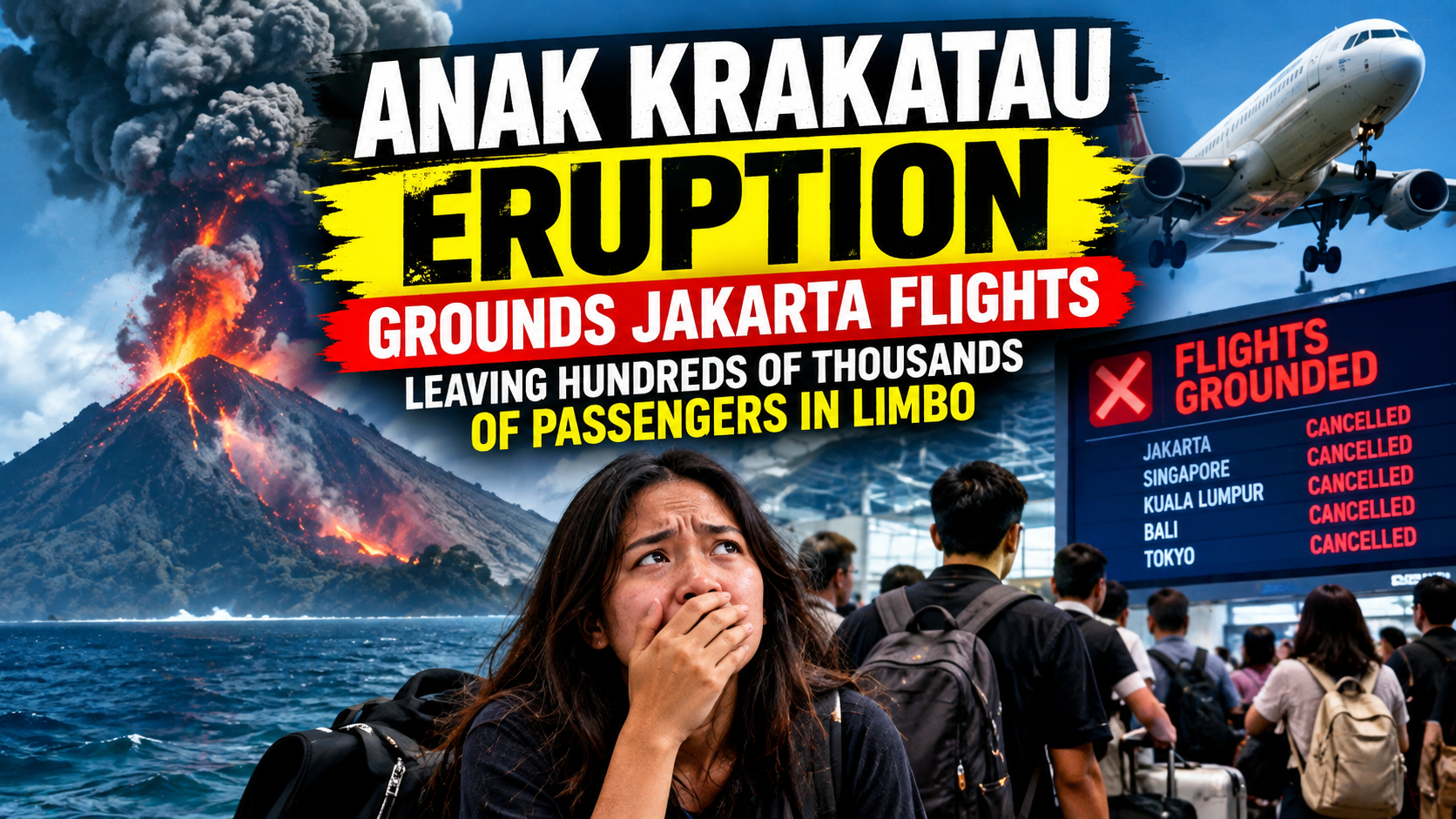
JAKARTA — The latest eruption of Indonesia’s Anak Krakatau volcano has sent disruption far beyond the Sunda Strait, pushing a vast cloud of volcanic ash into key flight paths and bringing operations at Jakarta’s main airport to a standstill.
Soekarno-Hatta International Airport, the principal gateway to Indonesia’s capital, was among eight airports temporarily closed after ash from the volcano was detected in surrounding airspace. The precaution underscored a hard rule of aviation: volcanic ash is not merely an inconvenience. It can impair visibility, damage aircraft systems and pose a severe risk to jet engines.
The volcano, known as the “Child of Krakatau,” began erupting late Friday, producing lava fountains, rumbling sounds and ash plumes that authorities said rose as high as 15,000 metres on the Sumatra side of the volcano. Its location in the Sunda Strait, between Java and Sumatra, placed ash directly in the path of some of Indonesia’s busiest aviation corridors.
The impact at Soekarno-Hatta was immediate. Flights were cancelled, delayed or diverted as airlines and airport authorities waited for conditions to improve. Departure halls filled with passengers searching for new itineraries, seeking refunds or simply watching flight-information boards for updates. Some travellers faced repeated rescheduling; others considered rail or road travel as uncertainty extended through the weekend and into the following week.
At the height of the disruption, officials said nearly 3,000 flights had been affected across the closed airports, with more than 340,000 passengers stranded or otherwise disrupted. More than 900 of the affected flights were linked to Soekarno-Hatta, according to reporting by Al Jazeera and the BBC.
The crisis also rippled beyond Indonesia. Flights on international routes, including services connecting Jakarta with Singapore, Kuala Lumpur, Doha and Sydney, were disrupted. Airlines including Singapore Airlines and Scoot cancelled selected Jakarta services as the ash cloud spread, according to CNBC.
Authorities have since reopened Soekarno-Hatta and several other airports after changing winds moved ash away from Jakarta’s airspace. But reopening does not mean an instant return to normal. Airlines still face a backlog of disrupted passengers, and officials must ensure aircraft exposed during the closure are fit to resume service. The volcano itself remains at Indonesia’s Level III alert status, with authorities warning that further eruptions remain possible.
For passengers, the episode has turned routine travel into a test of patience. Airport closures may be temporary, but the consequences—missed connections, extended hotel stays, cancelled holidays and postponed work trips—can linger long after the runway reopens.
Anak Krakatau’s renewed activity is also a reminder of the region’s volcanic vulnerability. The volcano emerged from the caldera left by the catastrophic 1883 Krakatau eruption and remains one of Indonesia’s closely monitored geological threats. While authorities have said the current eruptions do not present an imminent tsunami risk, the aviation disruption demonstrates how quickly a natural event can affect a nation’s mobility and regional connectivity.
As airlines work through delayed schedules and passengers await firmer travel plans, Jakarta’s airport is again operating—but under the shadow of a volcano whose activity remains unpredictable.