






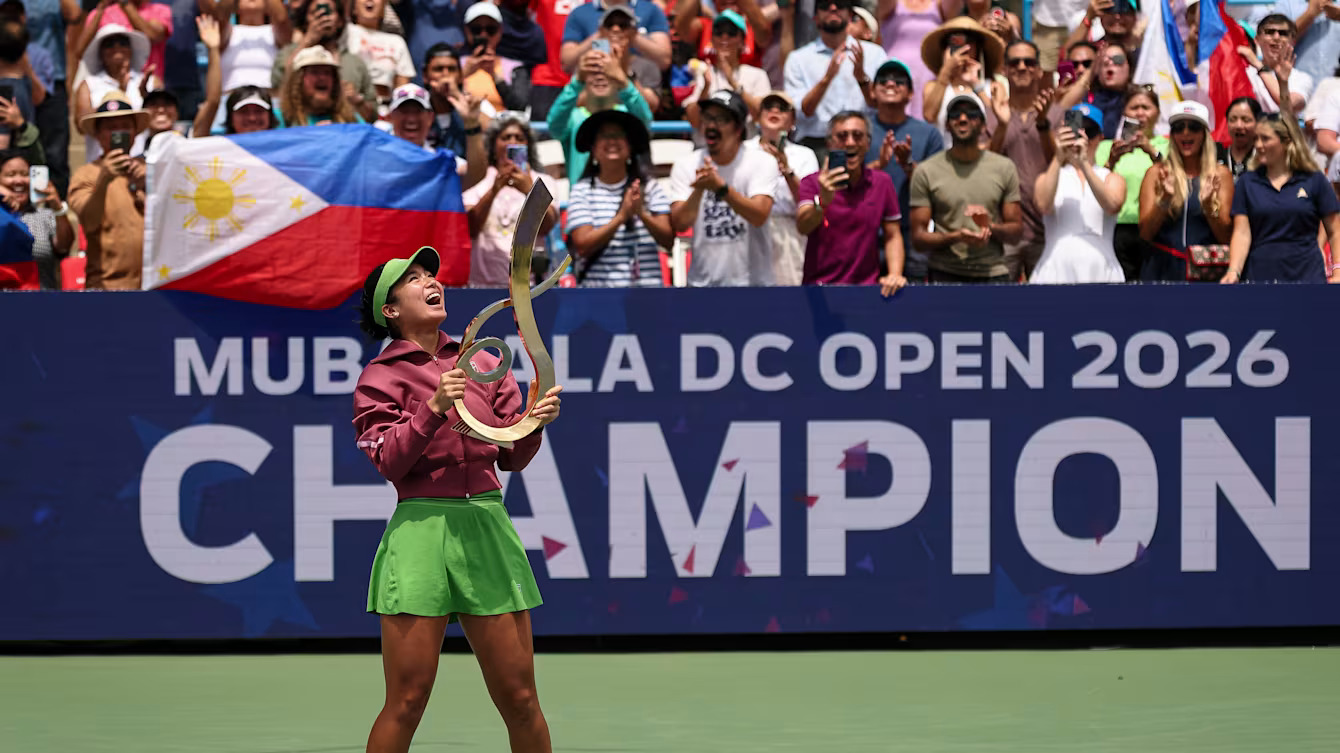
WASHINGTON — At 21, a left-handed prodigy from Manila has done what no Filipino tennis player had done before — and Rafael Nadal is cheering her on.
On a rain-soaked Monday in the nation’s capital, before what tournament director Mark Ein called the most anticipated crowd in Washington Open history, Alexandra Eala walked onto the court with the weight of a nation on her shoulders and a phrase stitched to the back of her cap: “Kapag lumago, hindi na hihinto.” Once it grows, it cannot be stopped.
By the time she struck her final winner against world No. 3 Jessica Pegula — completing a stunning 4-6, 6-4, 6-0 comeback in the final of the 2026 Washington Open — that slogan had begun to feel less like personal motivation and more like a national prophecy.
With the victory on August 3, Eala became the first player from the Philippines ever to win a WTA Tour-level singles title. At 21 years old, she stands ranked a career-high No. 20 in the world. And in a country of 120 million people where basketball, boxing and beauty pageants have long defined the sporting imagination, she has done something more than win a tennis match. She has altered the landscape.
A Champion Forged in Unlikely Places
Eala’s story begins not on the manicured grass of Wimbledon or the hardcourts of Washington, but on converted basketball courts in Quezon City, where a four-year-old girl was handed a racket by her maternal grandfather, Bobby Maniego. It was an odd inheritance in a country where an hour of court time in Manila can cost a family nearly 2,000 pesos — roughly $32 — placing the sport well beyond the reach of most aspiring young players.
Eala’s run through the Washington draw read like a who’s who of women’s tennis — Zheng Qinwen, Olympic gold medalist; Leylah Fernandez, the defending Washington champion; Elina Svitolina, the second seed; Naomi Osaka, third seed and four-time Grand Slam winner. All fell before her. Pegula, the top seed, would be next.
Yet the sport took hold. By the time Eala was 13, she had won the under-14 girls’ singles at Les Petits As in France, one of the world’s most prestigious junior tournaments, and earned a scholarship to the Rafa Nadal Academy in Mallorca, Spain. There, surrounded by the best young players in Europe, she shaped her game around what she had — extraordinary footwork, fierce mental resolve and a left-handed groundstroke that bore an unmistakable resemblance to the man whose name was on the academy door.
In the summer of 2023, Nadal himself handed Eala her graduation diploma, with world No. 1 Iga Swiatek seated in the audience. Within two years, Eala would defeat Swiatek not once but twice on the Grand Slam stage — first in Miami, then at Wimbledon.
This week, upon learning of his former student’s Washington triumph, Nadal was effusive. “Congratulations Alexandra!” he wrote on social media. “What an incredible week in Washington. A well-deserved title given the hard work. Congratulations to the Philippines and the whole Academy team!”
Dismantling the Draw, One Star at a Time
If the final was a statement, the path to it was a masterclass. Eala’s run through the Washington draw read like a who’s who of women’s tennis — Zheng Qinwen, Olympic gold medalist; Leylah Fernandez, the defending Washington champion; Elina Svitolina, the second seed; Naomi Osaka, third seed and four-time Grand Slam winner. All fell before her. Pegula, the top seed, would be next.
“Over the last month, at least 80 percent, if not more, of the requests from the ticketing team are about when Alex Eala is playing,” Ein told reporters courtside. It was a staggering statistic for a player who had yet, until Monday, to win a WTA singles title.
Pegula, gracious in defeat, offered her own tribute to the forces Eala has set in motion. “To all the Filipino fans that came out and have supported — you guys are helping to grow tennis around the world,” she said. “Being a female athlete, being in tennis, we love to see that growth.”
Tennis in a Basketball Nation
Eala’s breakthrough has illuminated, with uncomfortable clarity, the structural barriers facing Filipino athletes. The Philippine Sports Commission’s annual budget stands at approximately $23.3 million — less than what many American college football programs spend on player support alone. For a sport like tennis, which requires courts, coaching, travel and equipment, the economics are particularly daunting.
The political response to Eala’s rise has been swift, if belated. Philippine senators have filed eleven separate commendation resolutions in her honor, several explicitly calling on the government to establish a national talent identification system — an acknowledgment, remarkable in its candor, that no such program currently exists. President Ferdinand R. Marcos Jr. praised Eala for continuing “to redefine what is possible for Philippine tennis and inspire countless young Filipinos to dream without limits.”
Eala herself has observed the cultural shift with quiet satisfaction. Courts she once found empty, she says, are beginning to fill. Clubs are refurbishing facilities. Training programs are reaching players from backgrounds that, not long ago, would have foreclosed any path to the professional game.
A Family Built for This Moment
Eala does not come from nowhere. Her mother, Rizza Maniego-Eala, won a bronze medal in the 100-meter butterfly at the Southeast Asian Games and later became chief financial officer of Globe Telecom, the Philippines’ largest telecommunications company. Her uncle, Noli Eala, served as commissioner of the Philippine Basketball Association. Athletics and achievement are the family’s native language.
But genetics and pedigree explain only so much. What distinguishes Eala, by all accounts, is her capacity for suffering and recovery — a quality evident nowhere more clearly than in Monday’s final, where she fell a set and an early break behind before dismantling Pegula with a relentless 6-0 third set that stunned even the partisan Filipino crowd that had come to cheer her on.
What Comes Next
Eala now heads to the Canadian Open and the Cincinnati Open, and from there, to the US Open — the final Grand Slam of the season. She enters New York unencumbered by ranking pressure, her No. 20 world ranking providing a kind of freedom that, just a year ago, seemed unimaginable.
The cap she wore in Washington has already become something of an icon among Filipino sports fans. Kapag lumago, hindi na hihinto. Once it grows, it cannot be stopped.
For Philippine tennis — for Philippine sport, really — the growing has well and truly begun.
Alexandra Eala’s next tournament appearances are scheduled at the Canadian Open in Montreal and the Cincinnati Open, ahead of the 2026 US Open. (JC)