








STOCKHOLM — Global military spending reached $2.7 trillion in 2024, accounting for 2.5% of the world’s GDP, as nations grappled with armed conflicts, geopolitical rivalries, and strategic competition, according to a new report from the Stockholm International Peace Research Institute (SIPRI).
The data, released Monday, highlights stark disparities in defense priorities, with countries embroiled in conflicts spending significantly more relative to their economies than those at peace. Ukraine led the world, allocating a staggering 34% of its GDP to defense amid its ongoing war with Russia—a tenfold increase from 3.4% in 2021, before the conflict escalated.
“Countries facing direct threats or active conflicts are prioritizing military readiness, often at the expense of other sectors,” said Nan Tian, a senior researcher at SIPRI. “The data reflects not just regional tensions but a broader global trend toward rearmament.”
Regional Hotspots Drive Spending
The Middle East, a region marked by persistent conflicts, spent an estimated $243 billion on defense in 2024. Israel, facing heightened security challenges, dedicated 8.8% of its GDP to its military, while Saudi Arabia, the region’s top spender, allocated 7.3%. In North Africa, Algeria doubled its military budget to 8.0% of GDP from 4.1% in 2022, fueled by the ongoing Western Sahara dispute with Morocco.
Russia, locked in a protracted conflict with Ukraine and facing rising tensions with NATO, increased its military spending by 38% from 2023, reaching 7.1% of its GDP. The surge underscores Moscow’s focus on sustaining its war effort and countering Western alliances.
Top 10 Countries by Military Spending as % of GDP (2024)
- Ukraine: 34.0%
- Israel: 8.8%
- Algeria: 8.0%
- Saudi Arabia: 7.3%
- Russia: 7.1%
- Kuwait: 4.8%
- Poland: 4.2%
- United States: 3.4%
- Colombia: 3.4%
- Greece: 3.1%
NATO’s Growing Defense Commitments
In 2024, 18 of NATO’s 32 member states met or exceeded the alliance’s guideline of spending at least 2% of GDP on defense, a benchmark set in 2014. Poland led the pack, allocating 4.2% of its GDP to its military as tensions with neighboring Russia intensified. European NATO members collectively accounted for 30% of the alliance’s total spending.
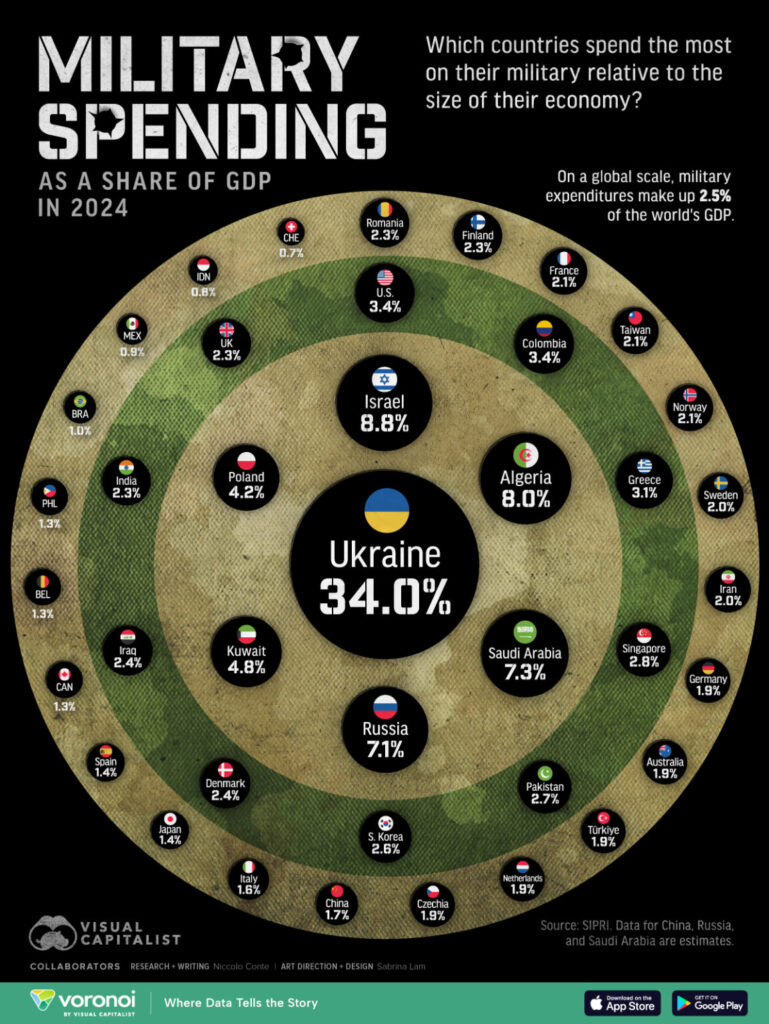
The United States remained the world’s largest military spender, contributing $1 trillion—over one-third of global military expenditure—and accounting for 66% of NATO’s total defense budget. At 3.4% of GDP, U.S. spending reflects its role as a global superpower amid strategic competition with China and other powers.
Global Trends and Disparities
SIPRI’s data reveals a clear divide: countries engaged in armed conflicts spent an average of 4.4% of their GDP on defense, compared to 1.9% for those in peace. The top 20 countries by military spending as a share of GDP included conflict-affected nations like Ukraine, Israel, and Russia, alongside others prioritizing strategic deterrence, such as Saudi Arabia and Algeria.
Other notable spenders included Kuwait (4.8%), Colombia (3.4%), and Greece (3.1%), each driven by regional security concerns or internal challenges. The global average of 2.5% masks significant variation, with wealthier nations often spending less as a percentage of GDP due to their larger economies, while smaller or conflict-ridden states bear heavier burdens.
Implications for Global Stability
The rise in military spending reflects a world increasingly defined by mistrust and competition, analysts say. From the Russia-Ukraine war to Middle Eastern conflicts and U.S.-China rivalry, nations are bolstering their arsenals to project power or ensure survival.
“High military spending can stabilize in the short term but risks fueling arms races in the long run,” Tian said. “The challenge is balancing security needs with investments in diplomacy and development.”
As global tensions show no signs of abating, SIPRI’s report serves as a stark reminder of the economic and human costs of prioritizing defense in an uncertain world. [Source: Stockholm International Peace Research Institute (SIPRI)]